
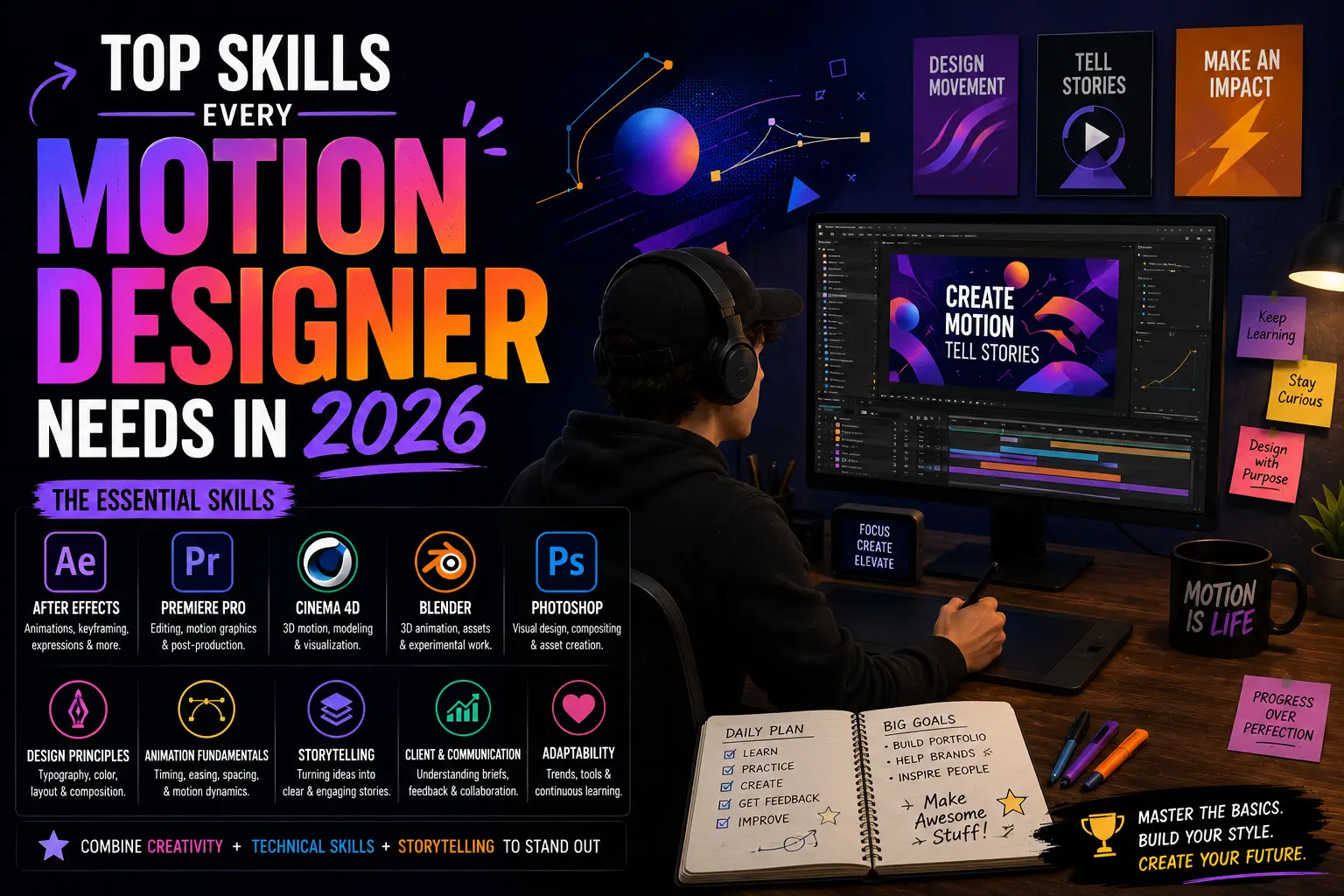
Motion design is one of the fastest-evolving disciplines in the creative industry. The tools have changed dramatically over the past decade, the demand for motion content has expanded across every platform and medium, and the expectations placed on professional motion designers have grown to match. Whether you are just starting out or looking to stay competitive at a senior level, understanding which skills matter most in 2026 — and developing them deliberately — is essential for building a strong, sustainable career in motion design.
This guide covers the core technical skills, software proficiencies, and creative capabilities that define a well-rounded motion designer in 2026. If you are actively looking for motion design roles, you can browse current motion designer job openings on PixelCareer.
1. After Effects — The Non-Negotiable Foundation
Adobe After Effects remains the industry-standard tool for motion graphics, compositing, and visual effects work across advertising, broadcast, streaming, and digital media. In 2026, proficiency in After Effects is not a differentiator — it is a baseline requirement for almost every motion design role.
Beyond basic keyframing and layer animation, the motion designers who stand out are those who have developed deep After Effects proficiency:
- Expressions — the ability to write and understand JavaScript-based expressions in After Effects automates repetitive tasks, creates procedural animations, and enables complex motion systems that would be impractical to keyframe manually. Expressions fluency is one of the most valued technical skills a motion designer can have.
- Shape layer animation — advanced shape layer techniques allow for highly complex, scalable vector animations without leaving After Effects. This is particularly valuable for UI animation, explainer video work, and brand motion.
- Plugin ecosystem — familiarity with widely used plugins including Motion Bro, AEJuice, and in particular Cinema 4D Lite (which ships with After Effects) significantly extends what you can produce within the tool.
2. Cinema 4D or Blender — 3D Is Now Expected
The integration of 3D into motion design workflows has moved from a specialist skill to a broadly expected capability. Clients, agencies, and studios increasingly expect motion designers to produce work that incorporates 3D elements — and candidates who cannot are at a meaningful disadvantage in competitive hiring situations.
Cinema 4D has historically been the most common 3D tool in motion design workflows due to its tight integration with After Effects via Cineware. It remains widely used in advertising, broadcast, and brand motion contexts.
Blender has experienced extraordinary growth in adoption across the motion design community. Its open-source nature, rapidly improving feature set, and the quality of its rendering engine have made it a genuine professional tool — and one that an increasing number of studios accept or prefer. Blender proficiency is now a legitimate differentiator for motion designers who want to work in more technically ambitious environments.
You do not need to master both. Developing solid proficiency in one 3D tool — enough to model simple objects, apply materials, light a scene, and render — meaningfully expands the scope of work you can produce and the roles you are competitive for.
3. Design Fundamentals — The Skill That Separates Good From Great
Motion design is, first and foremost, design. The technical skills matter enormously — but they serve the design. Motion designers who have a strong foundation in visual design principles consistently produce better work than technically proficient artists who lack design sensibility.
The core design fundamentals every motion designer should develop:
- Typography — understanding type hierarchy, legibility, and typographic motion is essential for title design, lower thirds, and any motion work involving text. Strong typography often separates professional motion design from amateur work more clearly than any other single element.
- Colour theory — understanding how colours interact, how to build a palette, and how colour communicates mood and brand identity is fundamental to producing work that feels intentional and polished.
- Composition and layout — the principles of visual composition — balance, hierarchy, negative space, and visual flow — apply directly to motion design. A frame that is well-composed at rest will produce more satisfying motion than one that is not.
- Timing and rhythm — the feel of a motion piece is largely determined by the timing of its animations. Understanding how to use easing, anticipation, and follow-through to create motion that feels natural and expressive is one of the core creative skills of the discipline.
4. Premiere Pro and Video Editing Fundamentals
Motion designers are increasingly expected to have working knowledge of video editing — not at the level of a dedicated editor, but enough to cut sequences, handle audio, and deliver finished videos without relying on a separate post-production workflow.
Adobe Premiere Pro is the most common editing tool in motion design contexts. Familiarity with the Premiere workflow, basic colour grading, audio mixing, and export settings for different delivery formats is a practical skill that makes you significantly more useful to clients and smaller studios where role boundaries are less rigidly defined.
5. Rive and Real-Time Animation Tools
One of the most significant shifts in motion design in recent years has been the growth of real-time and interactive animation, driven by the expansion of app design, web animation, and interactive media. Rive has emerged as the leading tool for this category — enabling motion designers to create interactive animations that respond to user input and can be deployed directly in apps and websites without the need for developer translation.
Rive proficiency is currently a genuine differentiator rather than a baseline requirement. Motion designers who can produce interactive animations for digital products are in demand at technology companies, UX-focused studios, and product design agencies that are looking to bring motion into their design systems.
You can find motion designer roles that require Rive and interactive animation skills on PixelCareer.
6. AI Tools — Augment, Do Not Replace
Generative AI tools have entered the motion design workflow in 2026 in a meaningful way. Tools like Adobe Firefly, Runway, and Midjourney are being used by motion designers to generate reference imagery, create texture assets, develop styleframes, and accelerate early-stage concepting.
The motion designers who benefit most from AI tools are those who understand them as workflow accelerators rather than creative replacements. AI-generated assets require significant refinement, art direction, and integration skill to produce professional results — and the motion designer’s eye for quality, composition, and motion principles remains the critical factor in determining whether the final output is excellent or mediocre.
Developing familiarity with AI tools in your workflow is worth doing — but developing your core design and animation skills remains far more important for long-term career viability.
7. Brand and Style Fluency
A significant proportion of professional motion design work involves translating existing brand identities into motion — creating animations that feel consistent with a company’s visual language, tone, and values. The ability to work within a brand system, follow a style guide, and make motion decisions that feel coherent with an established aesthetic is an essential professional skill that is rarely taught explicitly.
Develop brand fluency by studying how major brands approach motion — observe how companies like Apple, Google, Nike, and Airbnb animate their brand assets. Pay attention to the consistency of their motion language across contexts. Practice recreating brand motion styles as exercises, then develop your own motion language in personal projects.
8. Storyboarding and Styleframing
Before a motion piece is animated, it typically goes through a storyboarding or styleframing phase — the process of visually planning the sequence and establishing the aesthetic direction of the piece. Motion designers who can contribute to this phase are significantly more valuable to agencies and studios than those who can only execute animation once the direction is established.
Storyboarding does not require illustration skill at the level of a dedicated artist. It requires the ability to communicate visual ideas clearly — rough thumbnails that convey camera movement, composition, and sequence are sufficient in most production contexts.
Styleframes — polished still images that establish the visual direction of a motion piece — do require stronger design skill and are typically produced in tools like Photoshop, Illustrator, or directly in After Effects or Cinema 4D. Developing the ability to produce compelling styleframes is one of the higher-value skills a motion designer can build.
9. Client Communication and Creative Direction Skills
At mid-level and above, the motion designers who advance most quickly are those who can communicate effectively with clients, take creative briefs, ask the right questions, and translate often vague creative direction into concrete visual decisions. This skill is rarely mentioned in job descriptions but is consistently cited by creative directors as one of the primary differentiators between good animators and genuinely valuable creative contributors.
Developing client communication skills takes practice — but it starts with taking every brief seriously, asking clarifying questions before you begin animating, and presenting your work with a clear rationale for the decisions you made rather than simply showing the output and waiting for feedback.
10. A Strong, Focused Portfolio
Every skill on this list is demonstrated through your portfolio. A motion designer’s portfolio is their primary professional asset — the evidence of everything they can do, presented in the most compelling way possible.
In 2026, a strong motion design portfolio typically includes:
- A showreel of 60 to 90 seconds featuring your best work, paced well and edited to music
- Individual project case studies that show your process — styleframes, storyboards, and the thinking behind the work, not just the final animation
- A range of work that demonstrates both technical proficiency and design sensibility
- At least one piece that shows 3D integration
- Work that demonstrates brand fluency — pieces made within an existing visual identity
Host your portfolio on a personal website or on platforms like Behance or Vimeo. Keep it current — replace weaker pieces as your skills develop and lead always with your strongest, most recent work.
Frequently Asked Questions
What software do motion designers use most in 2026?
Adobe After Effects remains the primary tool for most motion design work. Cinema 4D and Blender are widely used for 3D integration. Adobe Premiere Pro handles video editing and finishing. Rive is growing rapidly for interactive and real-time animation. Most motion designers use a combination of these tools depending on the project type and client requirements.
Do motion designers need to know how to code?
Full coding ability is not required, but understanding expressions in After Effects — which are based on JavaScript — is a highly valued skill. Motion designers who work in interactive contexts, particularly those using Rive or working with development teams on web or app projects, benefit from a basic understanding of how their animations will be implemented technically.
Is 3D animation necessary for motion designers?
3D skills are increasingly expected rather than optional. The majority of commercial motion design work in 2026 incorporates some 3D elements, and candidates who cannot produce 3D work are at a disadvantage in competitive hiring situations. You do not need to be a specialist 3D artist — a working knowledge of Cinema 4D or Blender sufficient to model, light, and render simple scenes is the practical standard most studios require.
How important is a motion design degree?
A degree is not required to work as a professional motion designer. What studios and clients care about is the quality of your portfolio and your ability to produce professional work. Many successful motion designers are self-taught or attended short specialist courses. That said, a structured education can accelerate skill development if the programme has strong industry connections and teaches current professional tools and workflows.
What is the best way to improve as a motion designer?
The most effective ways to improve are: making work consistently — personal projects keep your skills sharp and your portfolio fresh; studying work you admire — breaking down how pieces you love were made teaches you techniques you cannot learn any other way; seeking feedback from more experienced designers; and staying current with new tools and techniques through the motion design community on platforms like YouTube, Motionographer, and School of Motion.
Final Thoughts
Motion design in 2026 rewards designers who combine strong technical tool proficiency with genuine design sensibility, effective communication, and the curiosity to keep learning as the discipline evolves. The tools will continue to change — AI will become more integrated, new platforms will create new formats, and the boundary between motion design and interactive design will continue to blur.
The motion designers who build the most resilient careers are those who develop deep craft skills that transcend any single tool, and who stay engaged with the industry community as the discipline grows and changes around them.
If you are ready to put your skills to work, browse motion design and multimedia jobs on PixelCareer and find your next opportunity at a leading studio or agency.