
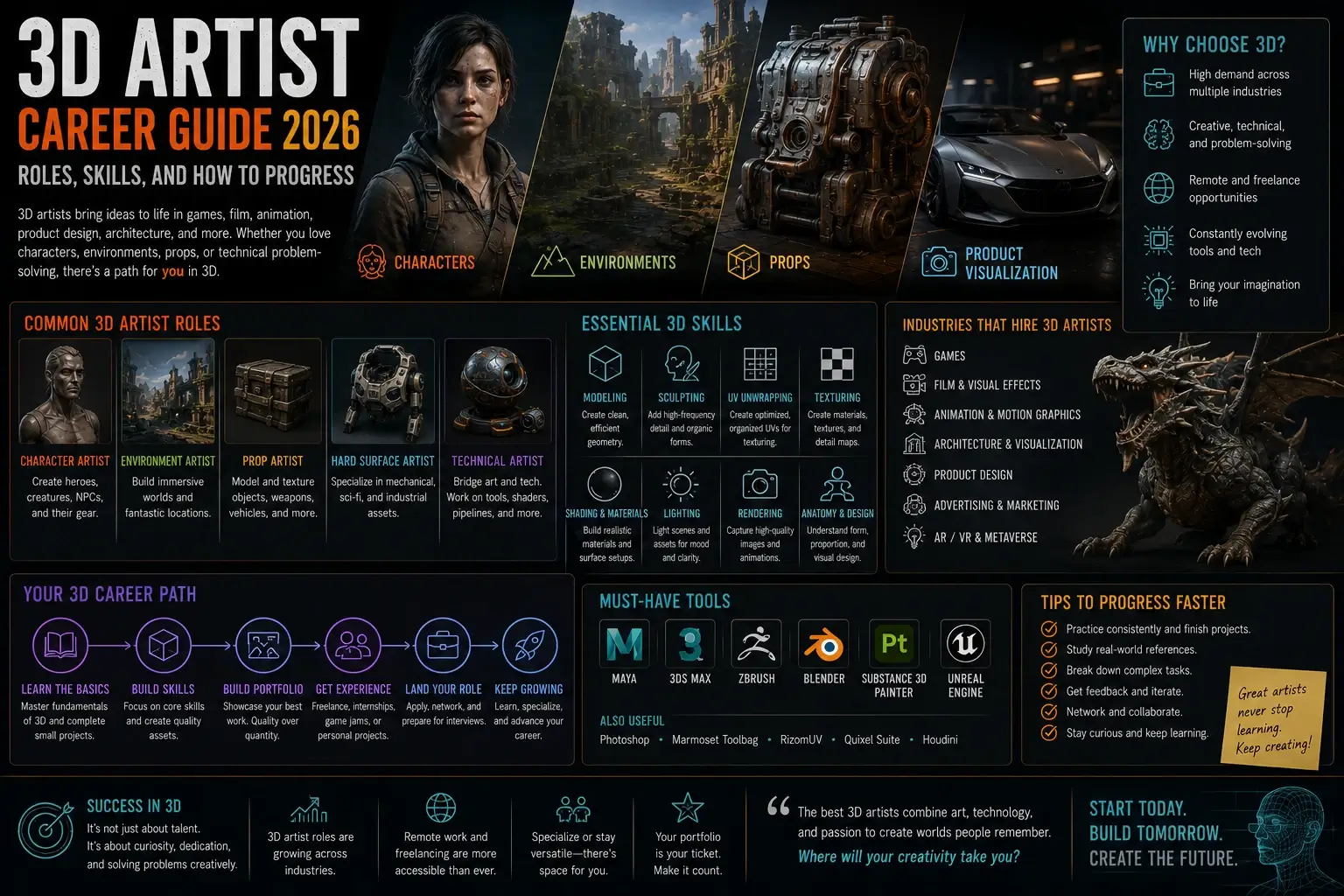
3D art is one of the most in-demand creative disciplines across the entertainment, gaming, advertising, and technology industries in 2026. The demand for skilled 3D artists spans games studios, VFX houses, animation studios, product visualisation agencies, and the emerging worlds of AR, VR, and real-time 3D experiences. Whether you are just starting out with modelling fundamentals or looking to specialise and advance your career, understanding the landscape of 3D art — the disciplines, the tools, the studios, and the career paths — is essential for building a successful and sustainable career.
If you are looking for 3D artist roles right now, browse current 3D artist job openings on PixelCareer across games, VFX, animation, and more.
The Different Disciplines Within 3D Art
3D art is not a single discipline — it is a family of related specialisations, each with its own skill requirements, tools, and career paths. Understanding the distinctions helps you choose where to focus your development and how to position yourself in the job market.
3D Modelling: Creating the geometric forms that make up characters, environments, props, and vehicles in a production. Modelling artists work in polygonal modelling, subdivision surface modelling, and increasingly in sculpting tools like ZBrush. Hard surface modelling (mechanical objects, architecture, vehicles) and organic modelling (characters, creatures, natural forms) are distinct sub-specialisations with different technical emphases.
Character Art: Specialising in the creation of character models — from high-resolution sculpts to game-ready topology. Character artists combine modelling, sculpting, retopology, and texturing skills to produce characters that are both visually compelling and technically optimised for animation and real-time rendering.
Environment Art: Creating the worlds that characters inhabit — terrain, architecture, vegetation, props, and the visual language of the game or production world. Environment artists balance visual quality with technical performance, building assets that look exceptional while meeting polygon count and memory budget requirements.
Texturing and Surfacing: Applying colour, material definition, and surface detail to 3D models using tools like Substance Painter, Substance Designer, and Mari. Texturing artists work closely with lighting and rendering teams to ensure that surfaces respond correctly to light and convey the intended material qualities.
Lighting: Defining how light behaves within a 3D scene — placing light sources, adjusting their qualities, and ensuring the final render conveys the intended mood, atmosphere, and visual hierarchy. Lighting artists work with both real-time engines in games contexts and offline renderers in film and VFX contexts.
Rigging: Building the joint systems, control rigs, and deformation systems that allow 3D characters to be posed and animated. Riggers work at the intersection of art and technology, requiring both an understanding of anatomy and movement and the technical knowledge to implement deformation systems that perform correctly under animation.
3D Generalist: Working across multiple 3D disciplines — modelling, texturing, rigging, and sometimes lighting and rendering — within a single production pipeline. Generalist roles are common at smaller studios and in freelance contexts where the breadth of skills a single artist brings is more valuable than deep specialisation in one area.
Essential Tools for 3D Artists in 2026
Maya: The industry-standard DCC (Digital Content Creation) tool for 3D modelling, rigging, and animation in film, TV, and games. Maya is required knowledge for most 3D artist roles at professional studios. Its animation tools, rigging systems, and pipeline integration capabilities make it the default choice across the largest productions globally.
Blender: The open-source 3D tool that has undergone extraordinary development since version 2.8 and is now widely used in professional production. Blender is accepted or preferred at a growing number of studios, particularly those in the indie, mid-sized, and advertising sectors. Its zero cost makes it the most accessible entry point for artists developing their skills.
ZBrush: The dominant tool for high-resolution 3D sculpting — essential for character artists, creature artists, and any 3D artist working on detailed organic or hard surface models. ZBrush proficiency is a near-universal requirement for character art and creature art roles.
Substance Painter and Substance Designer: The industry-standard tools for texturing and material creation. Substance Painter is used for texturing individual assets, while Substance Designer is used for creating procedural material graphs that can be applied across multiple assets. Both tools are expected knowledge for most 3D artist roles involving texturing.
Unreal Engine and Unity: Real-time game engines that 3D artists working in games need to understand — how assets are imported, how materials work within the engine, and how to optimise assets for real-time performance. Unreal Engine is increasingly used in film and TV production as well, making it relevant beyond game development contexts.
Houdini: Used by 3D artists specialising in procedural modelling, environmental generation, and simulation-driven asset creation. Houdini proficiency is a differentiator for environment artists and technical artists who want to work on large-scale world-building productions.
Building a 3D Art Portfolio
A strong 3D art portfolio is the primary determinant of whether you get hired in this discipline. Studios assess your portfolio before your CV, before your interview, and often before reading your cover letter. The standard required to get noticed at professional studios is high and rising continuously as the tools improve and the quality of work produced at every level increases.
Show final renders and wireframes: Always present your 3D work with both beauty renders — showing the model in the best possible light — and wireframe or clay renders that demonstrate the cleanliness and quality of your underlying topology. Studios want to see that your work is not just visually impressive but technically sound.
Include texture breakdowns: Show your diffuse, roughness, metalness, and normal maps individually alongside the final textured render. This demonstrates your understanding of the PBR (Physically Based Rendering) material workflow and your ability to produce textures that will behave correctly in a production environment.
Show game-ready and high-poly versions: For games artist roles, demonstrate that you understand the high-poly to low-poly pipeline — sculpting or building a high-resolution model, retopologising it for real-time use, and baking the detail from the high-poly onto the low-poly using normal maps.
Include real-time renders where relevant: For games artist roles, screenshots of your models in Unreal Engine or Unity — with appropriate materials and lighting — demonstrate that you understand how your work looks in the production context, not just in an offline renderer.
ArtStation is essential: ArtStation is the primary portfolio platform for 3D artists targeting games, film, and VFX. Maintaining an active, well-presented ArtStation profile is a professional baseline, not an optional extra.
Career Progression for 3D Artists
Junior 3D Artist (0 to 3 years): Working on supporting tasks — prop models, environmental details, texture updates — under direction from senior artists. Developing speed, technical quality, and familiarity with the production pipeline.
Mid-Level 3D Artist (3 to 6 years): Taking ownership of complete assets — characters, hero props, environmental structures — with greater independence. Meeting production quality standards consistently and beginning to contribute creative input to the art direction of the areas you work on.
Senior 3D Artist (6 to 10 years): Leading on the most technically and visually complex assets in a production, setting quality standards, mentoring junior team members, and contributing to art direction decisions. Senior 3D artists are often the primary creative voice for key assets in a production.
Lead 3D Artist or Art Lead: Managing a team of 3D artists on a specific area — characters, environments, props — reviewing work, giving direction, coordinating with other departments, and ensuring visual consistency across the area of responsibility.
Salaries for 3D Artists in 2026
- Junior 3D Artist: $45,000 – $65,000 USD / £27,000 – £38,000
- Mid-Level 3D Artist: $65,000 – $95,000 USD / £38,000 – £56,000
- Senior 3D Artist: $95,000 – $135,000 USD / £56,000 – £80,000
- Lead 3D Artist: $120,000 – $160,000 USD / £72,000 – £95,000
Character artists and technical artists typically earn at the higher end of these ranges due to the rarity and depth of skills required. Environment artists at large open-world game studios are also highly compensated given the scale and complexity of the work involved.
Frequently Asked Questions
Should I learn Maya or Blender first?
Blender is an excellent starting point — it is free, powerful, and increasingly accepted professionally. If you are targeting roles at major film, TV, and AAA game studios specifically, investing in Maya alongside Blender is worthwhile since many studios list it as a requirement. The core 3D concepts you develop in either tool transfer across both.
How important is ZBrush for a 3D artist career?
Very important for character and creature art roles. If you are targeting character art, creature art, or any role involving detailed organic sculpting, ZBrush proficiency is essentially a requirement. For environment art or hard surface modelling focused roles, it is less critical but still a valuable addition to your tool set.
What is PBR and why does it matter?
Physically Based Rendering is the material workflow used by all modern real-time game engines and most offline renderers. PBR materials define how surfaces respond to light using physically accurate parameters — albedo, roughness, metalness, and normal maps. Understanding and working within the PBR workflow is a baseline professional skill for any 3D artist working in games or modern production contexts.
Can I get a 3D artist job with only personal project work?
Yes — personal project work is accepted and valued in 3D art portfolios, particularly at the junior and mid-level. What matters is the quality and technical correctness of the work, not whether it was produced on a professional production. Strong personal work that demonstrates production-relevant skills will open doors at studios of all sizes.
Is there demand for 3D artists outside of games and film?
Significant and growing demand. Product visualisation, architectural visualisation, automotive design, e-commerce, advertising, metaverse and virtual experience development, medical visualisation, and educational content all employ 3D artists. This diversity of markets gives 3D art skills more career resilience than disciplines that are specific to a single industry sector.
Final Thoughts
3D art is one of the most versatile and in-demand creative disciplines in 2026. The tools are increasingly accessible, the market for skilled 3D artists is deep across multiple industries, and the ceiling for both creative expression and financial compensation is high for those who invest seriously in developing their craft.
Focus on your fundamentals — topology, proportion, material definition, and lighting — before chasing the latest tools or techniques. Build a portfolio that demonstrates technical quality and professional-standard output. And stay engaged with the 3D art community, which continues to push the quality of work produced at every level at an extraordinary pace.
Ready to find your next 3D artist role? Browse 3D artist jobs on PixelCareer across games, VFX, animation, and more.