
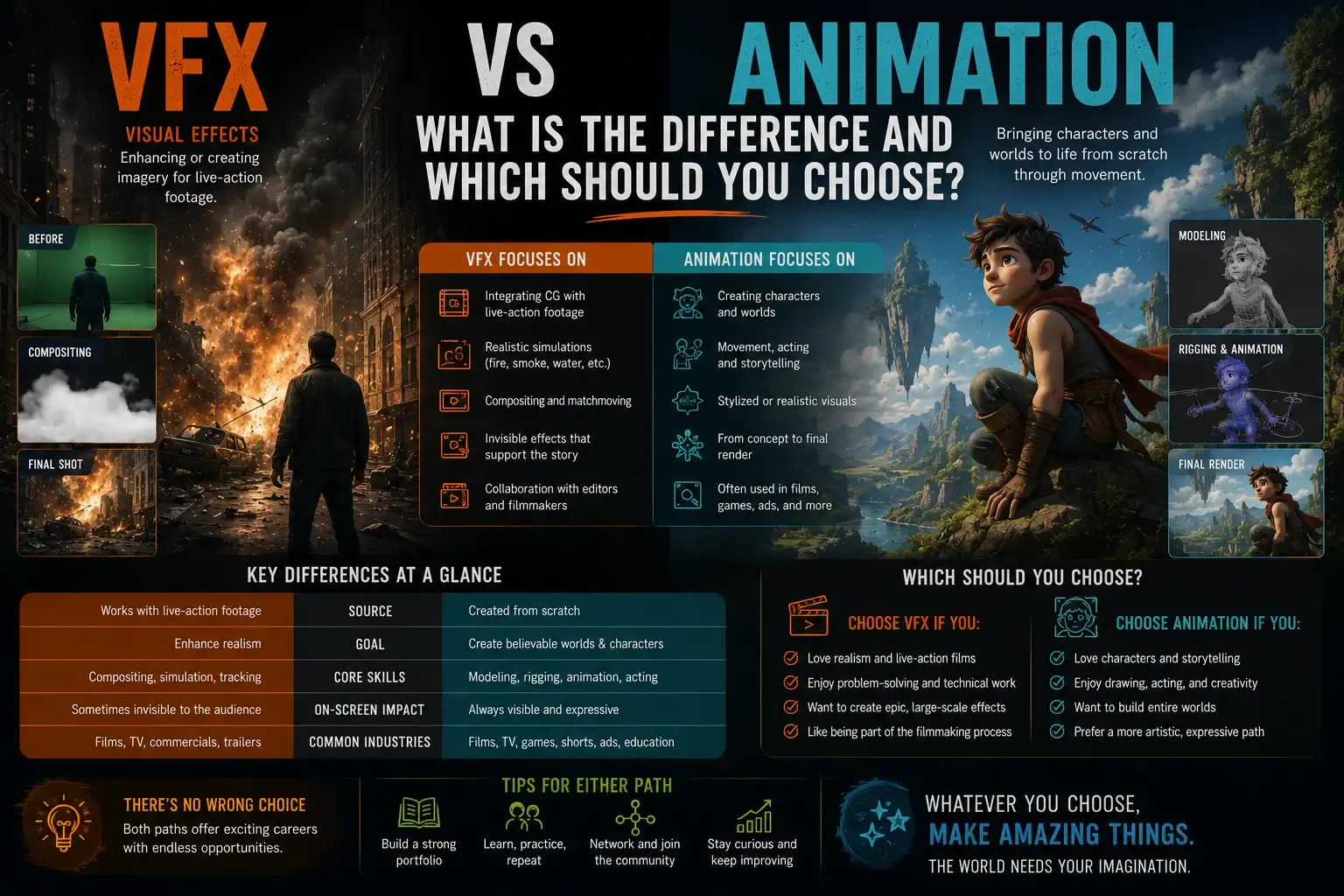
VFX and animation are two of the most visible and most frequently confused disciplines in the film, television, and games industries. They share tools, pipelines, and production environments — and the people who work in them often overlap in their skill sets — but they are fundamentally different disciplines with different creative objectives, different career paths, and different industry structures. If you are trying to decide which direction to pursue, or simply trying to understand how the two relate to each other, this guide covers everything you need to know.
You can explore roles in both disciplines on PixelCareer — browse animation jobs and browse VFX and post-production jobs to see the current range of opportunities available.
What Is the Difference Between VFX and Animation?
The clearest way to understand the difference between VFX and animation is to think about their primary creative purpose.
Animation is the creation of movement and performance from scratch. An animator creates the illusion of life in characters, creatures, and objects that did not originally move — bringing them to life through the careful placement of poses across time. Whether the medium is traditional 2D, stop-motion, or computer-generated 3D, animation is fundamentally an expressive art form concerned with creating convincing, emotionally resonant performances.
VFX — Visual Effects — is the integration of digital elements into live-action footage to create imagery that could not have been captured practically on set. VFX artists add digital environments to location footage, replace the sky in a shot with a storm, integrate a digital creature into a scene shot with a real camera on a real set, or destroy a building in a way that would be impossible or too dangerous to achieve practically. VFX is fundamentally a craft of seamless integration — making the artificial invisible.
The two disciplines overlap significantly in production — many major VFX shots include animated digital characters or creatures, and animated productions often include VFX work such as particle effects, fluid simulations, and environmental effects. But the creative objective and the primary skill set of each are distinct.
Career Paths in Animation
Animation careers span a remarkably wide range of industries and creative contexts. The most common career contexts for animators are:
Feature film animation: Working at studios like Pixar, Disney, DreamWorks, and Sony to produce theatrical animated features. Character animation is the primary skill required, with an emphasis on physical performance, emotional expression, and storytelling through movement.
Games animation: Working at games studios to animate characters, creatures, and objects within interactive experiences. Games animation requires additional technical knowledge beyond film — understanding real-time engines, state machines, and the constraints of interactive animation where the player’s input determines what happens next.
TV and streaming animation: Working on animated series for broadcast networks, streaming platforms, and online distribution. TV animation tends to operate on faster schedules and smaller budgets than feature film, requiring animators who can produce good work efficiently rather than spending weeks on a single shot.
Motion graphics and design animation: Animating graphic elements, typography, and visual systems for advertising, broadcast, and digital media. Motion graphics animation is more closely related to graphic design than to character animation, and is one of the more accessible entry points into professional animation work.
VR and real-time animation: An emerging and growing area where animators create content for virtual reality experiences, interactive installations, and real-time rendered environments. This specialisation requires understanding of game engine workflows and real-time performance constraints.
Career Paths in VFX
Visual effects careers are typically more technically demanding than animation careers, reflecting the complexity of the integration work involved. Common VFX specialisations include:
Compositing: The art of combining multiple digital and photographic elements into a seamless final image. Compositors work at the end of the VFX pipeline, integrating 3D renders, digital matte paintings, practical footage, and effects elements into the shots that appear on screen. Compositing requires strong visual sensibility, a deep understanding of colour science and photography, and proficiency in tools like Nuke.
FX and simulation: Creating the dynamic effects — fire, water, smoke, cloth, destruction, and crowd simulations — that populate VFX shots. FX artists work primarily in Houdini, building simulation setups that generate physically accurate or stylised effects from procedural systems. This is one of the most technically demanding VFX specialisations and is in consistently high demand.
Lighting and rendering: Setting up the digital lights, cameras, and rendering passes that produce the final look of a CG shot. Lighting artists need both artistic sensitivity — the ability to make a shot look beautiful and emotionally resonant — and technical understanding of rendering systems, shaders, and colour management pipelines.
Matte painting and environment: Creating digital environments — landscapes, cityscapes, and alien worlds — that exist entirely or primarily as painted or 3D-generated imagery rather than real locations. Matte painters work across both traditional digital painting tools and 3D software, often combining both to create vast, believable environments.
Rotoscoping and tracking: The foundational technical work of VFX — tracing objects in footage to create mattes, and tracking camera movement to ensure digital elements are correctly integrated with live-action. These specialisations are often entry points into VFX production, particularly at mid-sized and larger studios.
Tools: Where Animation and VFX Overlap
Despite their differences, animation and VFX share a significant portion of their software toolsets:
- Maya: Used for 3D animation across both disciplines — character animation in film and games, and digital character work within VFX productions
- Houdini: Dominant in VFX for simulation and procedural effects; increasingly used in animation for crowd systems, physics simulations, and procedural environments
- Nuke: The industry standard for compositing in both VFX productions and high-end animated features
- Unreal Engine: Used across games animation, virtual production, and increasingly for real-time VFX work
- After Effects: Used across motion graphics, broadcast animation, and lower-budget VFX work
Salary Comparison: Animation vs VFX
Salaries across animation and VFX are broadly comparable at equivalent experience levels, with some variation by specialisation. Technical VFX roles — particularly Houdini FX artists and compositors at senior level — tend to command slightly higher rates than equivalent animation roles, reflecting the depth of technical knowledge required.
- Junior Animator / VFX Artist: $45,000 – $70,000 (US) / £28,000 – £42,000 (UK)
- Mid-Level Animator / VFX Artist: $70,000 – $100,000 (US) / £42,000 – £60,000 (UK)
- Senior Animator / VFX Artist: $100,000 – $140,000 (US) / £60,000 – £85,000 (UK)
Freelance day rates for both disciplines range from £200 – £350 per day for junior practitioners to £600 – £900 per day for senior specialists in the UK market.
How to Choose Between Animation and VFX
If you are at the beginning of your career and trying to decide between animation and VFX, the most useful frame is to think about what type of problem most excites you.
If you are drawn to performance and storytelling — to the challenge of making a character feel alive, emotionally real, and physically believable — animation is likely the better fit. The best animators are fundamentally actors who work through movement rather than through voice and body, and the most rewarding parts of the work are about creating genuine emotional connection between characters and audiences.
If you are drawn to technical problem-solving and integration — to the challenge of making the impossible look real, of seamlessly blending digital and practical elements into something indistinguishable from reality — VFX is likely the better fit. The best VFX artists combine strong visual sensibility with deep technical knowledge, and the most rewarding parts of the work are about solving difficult problems in ways that nobody notices.
Frequently Asked Questions
Can you work in both animation and VFX?
Yes — many professionals work across both disciplines, particularly in games and motion graphics contexts where the boundary between animation and VFX is less defined. Technical animators and FX artists who work in games often develop skills that span both areas. That said, building depth in one discipline before expanding into the other is generally the more effective career development approach.
Is VFX harder to break into than animation?
Both are competitive, but VFX has a slightly steeper technical learning curve at entry level. The barrier to producing portfolio-quality VFX work is somewhat higher than for animation, partly because of the complexity of the tools and partly because the quality bar for integration work is extremely high — a VFX shot that almost works is more jarring than an animation that is slightly imperfect.
Which discipline has more job opportunities?
VFX employs a larger total number of people globally, driven by the extraordinary volume of streaming content being produced for platforms like Netflix, Amazon Prime, and Disney+. Animation employment is also growing, particularly in games and the broader motion graphics and brand animation market. Both disciplines offer strong employment prospects for qualified practitioners.
Do animation and VFX artists use the same software?
They share several major tools — particularly Maya, Houdini, Nuke, and Unreal Engine — but the depth of use and the specific workflows differ significantly. An animator uses Maya to create character performances; a VFX artist might use it to integrate a digital creature into live-action footage. The tools overlap, but the techniques and objectives are different.
Is it possible to transition from animation to VFX or vice versa?
Yes — particularly for animators moving into creature animation within VFX productions, or for VFX artists with compositing backgrounds transitioning into motion graphics or title design work. The transition requires developing new technical skills and building a relevant portfolio, but the shared foundational knowledge of 3D production and visual storytelling makes it more achievable than transitioning from an entirely different industry.
Final Thoughts
Animation and VFX are both extraordinary disciplines that offer creative and technically demanding careers with real longevity and significant global demand. The best choice between them is the one that aligns most closely with your natural strengths, your creative interests, and the type of problem-solving that genuinely excites you.
Whichever path you choose, the fundamentals remain the same — develop deep expertise, build a portfolio that demonstrates genuine quality, and stay connected to the communities and productions that are pushing the discipline forward.
Explore opportunities in both — browse animation jobs and browse VFX jobs on PixelCareer.