
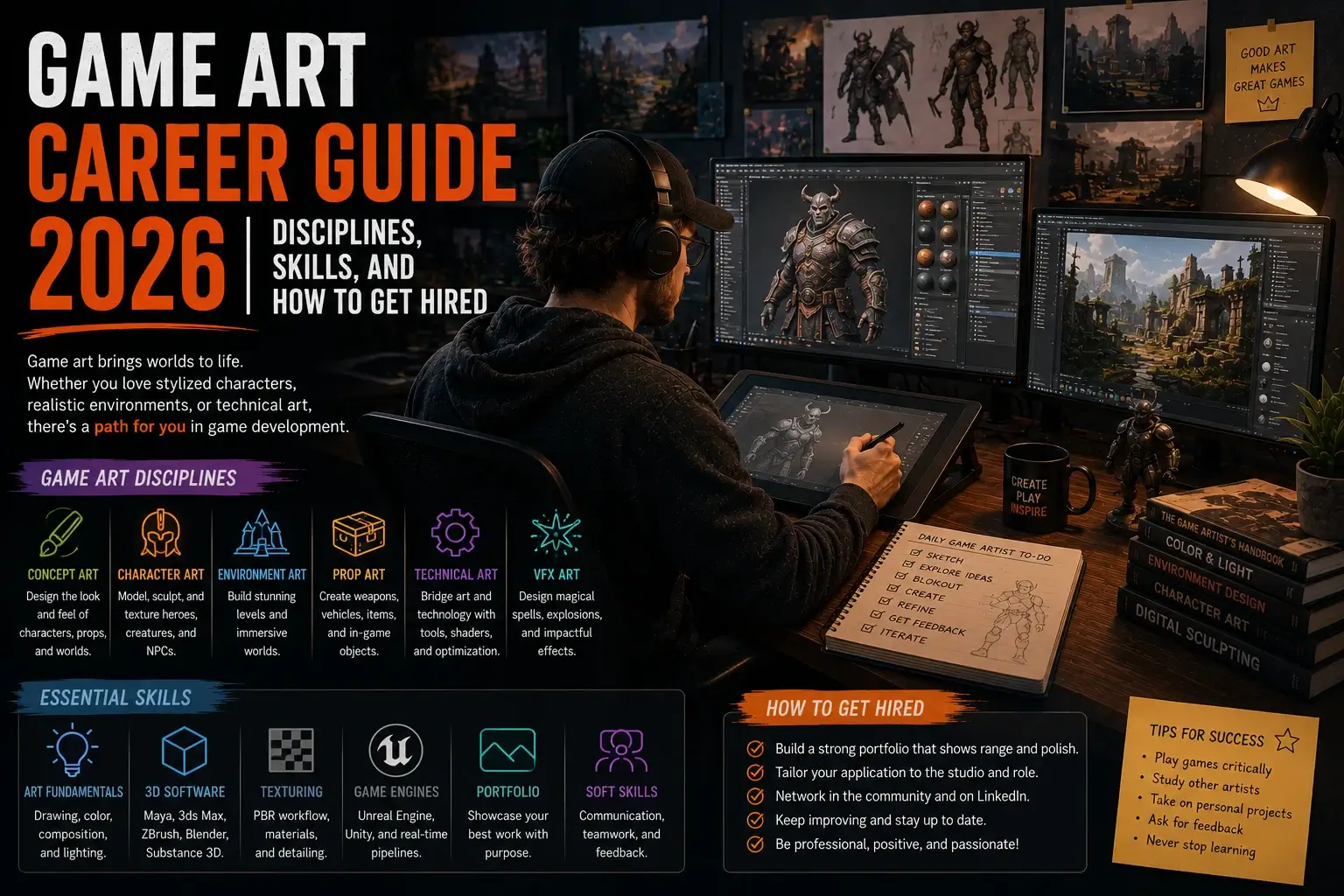
Game art is one of the most diverse and visually demanding disciplines in the creative industry. The artists who create the characters, environments, weapons, vehicles, and visual effects that populate games are responsible for the most immediate and lasting impression players have of any title. In 2026, the demand for skilled game artists spans every platform — from AAA console titles and PC games to mobile games, VR experiences, and indie releases — and the range of specialisations within the discipline is broader than ever. Whether you are starting out or looking to progress your existing game art career, this guide covers everything you need to know.
If you are ready to explore current opportunities, browse game art jobs on PixelCareer and discover what studios are currently hiring.
The Scope of Game Art
Game art is not a single skill — it is a family of related disciplines, each with its own skill set, tools, and career path. Understanding the landscape of game art specialisations is the first step to choosing the right direction for your career.
Character Artist: Creates the 3D models of characters — from the initial high-resolution sculpt through to the game-ready low-poly model with baked textures and materials. Character artists work closely with concept artists to realise character designs in 3D, and with riggers and animators to ensure models deform correctly.
Environment Artist: Creates the 3D environments players explore — buildings, landscapes, interiors, and the thousands of individual assets that populate them. Environment artists combine modelling, texturing, and material work to create spaces that feel real, atmospheric, and consistent with the game’s visual direction.
Concept Artist: Creates the 2D illustrations and design documents that guide the entire art production. Concept artists define the visual language of characters, environments, and assets before any 3D work begins.
Texture Artist / Surfacing Artist: Specialises in the creation of materials and textures — the surface detail that determines how 3D models look when lit and rendered in the game engine. Proficiency in Substance Designer and Substance Painter is essential for most texture artist roles.
Technical Artist: Bridges art and engineering, working on shaders, tools, pipeline optimisation, and real-time performance. Covered in more detail in our technical artist career guide.
Lighting Artist: Responsible for the lighting setups within game levels — placing lights, configuring light probes and reflection captures, and ensuring the overall visual quality and performance of the lighting system.
VFX Artist: Creates the real-time visual effects that appear in games — explosions, magic spells, weather effects, environmental particles, and the hundreds of other effects that bring game worlds to life.
UI Artist: Designs and creates the interface elements players interact with — health bars, menus, inventory systems, maps, and all the other HUD and UI components that make information accessible and visually consistent with the game’s aesthetic.
Essential Skills for Game Artists in 2026
3D modelling: Strong 3D modelling skills are the foundation of most game art specialisations. Maya remains the most widely used 3D package in games pipelines, though Blender is increasingly accepted. For character and creature work, ZBrush sculpting is an additional essential tool.
Texturing and material creation: Substance Painter and Substance Designer have become industry standard tools for game texture and material work. Proficiency in the PBR (Physically Based Rendering) workflow — understanding how roughness, metalness, normal, and other texture maps interact within a real-time renderer — is expected across most game art roles.
Game engine experience: Working knowledge of Unreal Engine or Unity is essential for most game art roles. Artists need to understand how assets are imported, how materials are set up within the engine, how lighting interacts with assets, and how to optimise their work for real-time performance.
Optimisation: Game art is constrained by real-time performance budgets in ways that film art is not. Understanding polygon budgets, texture memory, draw call optimisation, and LOD (Level of Detail) systems is a fundamental professional skill for game artists — the ability to produce high-quality visuals within tight technical constraints is what distinguishes professionals from students.
Anatomy and observation: For character and creature artists, a strong foundation in anatomy — both human and animal — is essential. The quality of a character model is ultimately determined by the accuracy and expressiveness of the underlying form, and that requires genuine knowledge of how bodies are constructed and how they move.
The Game Art Career Path
Junior Game Artist (0 to 2 years): Entry-level game artists typically work on secondary assets — props, environmental dressing, texture variations, and similar lower-stakes deliverables — under close direction from senior team members. The priority at this stage is developing speed, technical consistency, and a thorough understanding of the studio’s pipeline and quality standards.
Mid-Level Game Artist (2 to 5 years): At mid-level, you handle more complex assets with greater independence — hero props, secondary characters, and environment sections — and are expected to manage your own time and quality to a professional standard without close supervision. Cross-department communication becomes more important, as does the ability to implement feedback efficiently.
Senior Game Artist (5 to 8 years): Senior game artists handle the most complex and creatively significant assets on a production, mentor junior team members, contribute to technical and artistic decisions at a departmental level, and often have input into the visual direction of specific areas of the game.
Art Lead / Art Director: Art leads manage a team of artists within a specific discipline or game area. Art directors own the visual direction of the entire game — working closely with the creative director, game director, and other department heads to ensure the game’s art achieves its creative and business objectives.
Game Art Salaries in 2026
- Junior Game Artist (US): $45,000 – $65,000 per year
- Mid-Level Game Artist (US): $65,000 – $95,000 per year
- Senior Game Artist (US): $95,000 – $130,000 per year
- Art Lead (US): $120,000 – $160,000 per year
- Art Director (US): $140,000 – $190,000+ per year
In the United Kingdom, equivalent ranges are approximately £28,000 – £40,000 at junior level, £40,000 – £60,000 at mid-level, and £60,000 – £85,000 at senior level. Technical artists and lighting artists typically command salaries at the higher end of equivalent experience bands.
Building a Game Art Portfolio
Your portfolio is the entirety of your application for any game art role. Every piece needs to demonstrate production-quality output — the ability to create assets that meet professional standards, integrate correctly into a real-time engine, and contribute meaningfully to the visual quality of a shipped product.
Practical portfolio advice for game artists:
- Show your assets in context — within a game engine environment, with appropriate lighting and materials, rather than floating in a neutral render
- Include wireframes, texture sheets, and technical information alongside the beauty renders — studios want to understand your technical approach, not just the final result
- Demonstrate the complete workflow from concept or reference through to engine-ready asset
- Study the art style of the studios you want to work for and include at least one piece that demonstrates you can work within their aesthetic
- Quality over quantity — four to six exceptional assets will outperform a large number of mediocre ones
Frequently Asked Questions
What is the most in-demand game art specialisation in 2026?
Environment art and technical art are among the most consistently in-demand specialisations. The volume of environment content required for modern open-world games creates consistent demand for skilled environment artists. Technical artists who can optimise content and build pipeline tools are in demand at studios of all sizes.
Do game artists need to know how to use a game engine?
Yes — working knowledge of Unreal Engine or Unity is expected for most professional game art roles. Artists who can only produce assets but cannot integrate, light, and optimise them within a game engine are at a significant disadvantage in the current market.
Is a degree necessary for a game art career?
No — many successful game artists are self-taught or attended specialist art schools and bootcamps rather than traditional degree programmes. A strong portfolio demonstrating production-quality work is significantly more important than academic credentials for most game art roles.
What is the difference between a character artist and a character animator?
A character artist creates the 3D model — the visual representation of the character. A character animator brings that model to life through movement and performance. They are distinct roles requiring different skill sets, though both need to understand how the other’s work affects their own.
Can game artists work remotely?
Increasingly yes — particularly for mid-level and senior artists with professional experience and strong remote work track records. Many studios now offer hybrid arrangements, and some have moved to fully remote models for art roles. Check individual studio remote work policies, as they vary significantly.
Final Thoughts
Game art in 2026 is a rich, diverse, and genuinely rewarding discipline with strong demand across every sector of the games industry. The combination of artistic skill, technical knowledge, and production discipline it requires makes it one of the most professionally satisfying creative careers available.
The path to a professional game art career runs through your portfolio — start building it now, make every piece as strong as you can, and keep developing your technical knowledge alongside your artistic skill. The studios are looking for artists who can deliver both.
Ready to find your next game art role? Browse game art jobs on PixelCareer and find your next opportunity at a leading studio.