
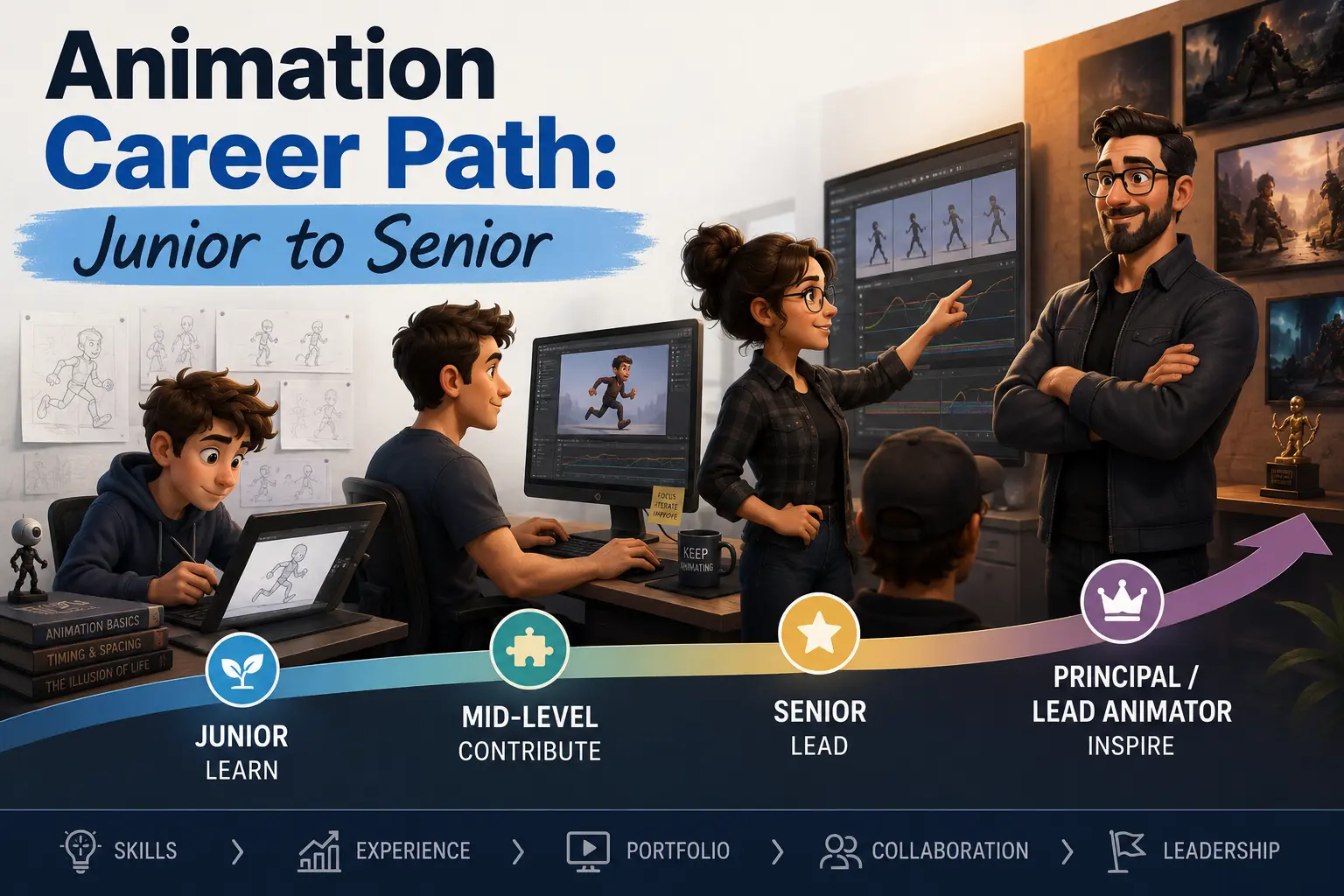
An animation career is one of the most rewarding paths in the creative industry — but it is also one of the least clearly mapped. Unlike professions with formal certification levels, the animation career path is largely defined by experience, portfolio quality, and the reputation you build across productions over time. Understanding what is expected at each stage — junior, mid-level, senior, and beyond — helps you develop the right skills, target the right roles, and position yourself for progression when the opportunity comes.
This guide covers the complete animation career path from entry-level to senior animator and beyond, including what skills you need at each stage, how long progression typically takes, and what actually separates the animators who advance quickly from those who plateau. If you are actively looking for your next animation role, you can browse current animator job openings on PixelCareer.
Understanding the Animation Career Ladder
Animation studios use different titles and have different expectations at each level. But broadly speaking, the animation career ladder follows a consistent structure across film, TV, games, and advertising. Understanding this structure helps you know where you stand, what you need to develop, and where you are heading.
The typical progression looks like this:
- Junior Animator — 0 to 3 years of professional experience
- Mid-Level Animator — 3 to 6 years
- Senior Animator — 6 to 10 years
- Lead Animator — 8 to 15 years
- Animation Supervisor / Director — 12 or more years
These are averages, not rules. Some animators reach senior level in five years. Others spend a decade at mid-level and produce exceptional work there. What matters most is the quality of your development, not the speed of your progression.
Stage 1 — Junior Animator
What the Role Involves
A junior animator is typically someone with one to three years of professional experience, or a recent graduate who has demonstrated strong foundational skills. At this stage, you are not expected to work independently on complex shots — you are learning how a professional pipeline operates, how to take direction, and how to deliver consistent, clean work within a production schedule.
Junior animators are often assigned secondary animation, crowd animation, or simpler character cycles and actions. You will spend significant time revising work based on feedback from leads and supervisors — and that feedback loop is one of the most valuable parts of the role.
Key Skills at This Level
- Solid understanding of the 12 principles of animation
- Proficiency in Maya, Blender, or the studio’s primary animation tool
- Ability to work cleanly within an established rig and pipeline
- Responsiveness to creative direction and willingness to revise
- Basic understanding of body mechanics and weight
What to Focus On
At the junior stage, your primary focus should be on absorbing as much as possible. Watch how leads approach shots. Ask questions. Understand why revisions are requested, not just what they are. Build a habit of animating outside of work — personal projects, 11 Second Club entries, and daily animation practice are what separate the juniors who progress quickly from those who plateau.
Stage 2 — Mid-Level Animator
What the Role Involves
After three to five years of professional experience, most animators move into a mid-level role. At this stage, you are expected to work with greater independence, handle more complex shots, and require less direct supervision on straightforward assignments.
Mid-level animators often take on full character performances, complex action sequences, and collaborative shots that require close coordination with other departments. You will still receive direction and feedback from leads, but you are expected to solve a higher proportion of problems independently before escalating.
Key Skills at This Level
- Strong character performance and acting ability
- Consistent technical quality with an efficient workflow
- Ability to interpret broad creative direction without detailed shot breakdowns
- Understanding of camera, staging, and shot composition
- Cross-department communication — working effectively with rigging, layout, and lighting teams
What to Focus On
The jump from junior to mid-level is largely about reliability. A mid-level animator is someone a lead can hand a shot to and trust that it will come back at an acceptable standard without significant handholding. Developing that reliability — consistent quality, on-time delivery, clean files — is what moves you out of the junior bracket.
Begin thinking about shots from a storytelling perspective, not just a technical one. The animators who progress to senior are the ones who can make creative decisions, not just execute instructions.
Stage 3 — Senior Animator
What the Role Involves
A senior animator typically has seven or more years of experience. At this level, you are expected to handle the most technically and creatively demanding shots on a production, mentor junior and mid-level animators, and contribute to creative decisions beyond your individual shot assignments.
Senior animators are often involved in shot review, setting the quality bar for a sequence, and solving animation problems that other team members have struggled with. You are a resource for the team, not just a producer of your own work. If you are ready for this level, view senior animator positions currently available on PixelCareer.
Key Skills at This Level
- Exceptional character performance and nuanced acting ability
- Deep understanding of the full production pipeline
- Ability to mentor and give constructive feedback to junior team members
- Strong problem-solving skills — both technical and creative
- Credibility with other departments and the ability to advocate for animation needs
What to Focus On
At the senior level, technical skill is largely assumed. What distinguishes the best senior animators is their ability to elevate the work of everyone around them. Mentoring is not optional at this stage — it is a core part of the role, and studios actively look for evidence of it when promoting or hiring at senior level.
Beyond Senior — Lead and Supervisory Roles
Animation Lead
An animation lead manages a small team of animators on a specific sequence or production. The role involves reviewing shots, giving feedback, coordinating with other department leads, and ensuring quality and consistency within your area of responsibility. Leads still animate — but a portion of their time shifts toward reviewing and supporting others.
Animation Supervisor
An animation supervisor is responsible for the animation department on an entire production. This is a senior leadership role involving creative direction across the whole project, stakeholder management with directors and producers, and high-level decisions about style, approach, and pipeline. Most animation supervisors have fifteen or more years of experience.
Animation Director
An animation director shapes the overall creative vision for animation across a feature, series, or franchise. This role is as much about creative leadership and communication as it is about technical knowledge. Animation directors work closely with the film director, VFX supervisor, and production leadership to ensure animation serves the story.
Specialist Paths Within Animation
Not all animation careers follow a linear generalist path. Many animators develop deep specialisations that define their career and make them highly valued in specific contexts.
Character Animator: Focuses on performance, acting, and character movement. The most common specialisation in film and games.
Technical Animator: Bridges animation and rigging, working on motion systems, real-time animation pipelines, and engine integration. Highly valued in games studios. You can learn more about what this role involves at Animation Career Review.
Motion Capture Animator: Specialises in cleaning, processing, and building upon mocap data. Film and AAA games studios hire specifically for this skill.
Cinematic Animator: Creates high-quality, film-style animations for in-game cutscenes and trailers. Common in AAA game development.
Creature Animator: Specialises in non-humanoid characters — creatures, animals, and fantastical beings. Requires deep understanding of anatomy and weight.
What Actually Accelerates Progression
Several factors consistently separate animators who progress quickly from those who plateau:
Active feedback seeking. Animators who regularly ask for critique — from leads, peers, and online communities — develop faster than those who work in isolation.
Personal projects. Studios notice animators who are making things outside of work. Personal projects demonstrate passion, initiative, and the ability to self-direct.
Breadth of production experience. Working across different studios, different styles, and different types of production accelerates development significantly.
Mentorship in both directions. Finding a mentor who is more experienced than you is valuable. Mentoring someone less experienced is equally valuable, because it forces you to articulate and examine your own practice.
Understanding the business. Animators who understand how productions work and how studios think about resource allocation become much more effective communicators with leads, supervisors, and producers.
Building Your Portfolio at Each Career Stage
Your portfolio needs to evolve as you progress. What works at junior level is not what gets you a senior interview.
Junior portfolio: Demonstrate foundational principles. Show clean body mechanics, believable weight and balance, and at least one piece of character performance. Four to six polished shots.
Mid-level portfolio: Show range and complexity. Include performance shots, action sequences, and ideally work from professional productions alongside personal projects.
Senior portfolio: Lead with your most impressive, most complex work. Show that you can handle difficult shots — physically complex action, nuanced emotional performance, creature work, or technically challenging scenarios. Include any leadership or mentorship examples if applying for lead roles.
Frequently Asked Questions
How long does it take to become a senior animator?
Most animators reach senior level between six and ten years into their career, though this varies considerably. The speed of progression depends on the quality of productions you work on, how actively you develop outside of work, and how well you absorb feedback. Some animators reach senior level in five years; others take longer and produce equally exceptional work.
Do I need a degree to become a professional animator?
A degree is not strictly required, but it is common. What studios care about most is your portfolio and your ability to do the work at a professional level. Many successful animators are self-taught or attended shorter specialist courses. Your reel will always carry more weight than your qualification.
What is the difference between a junior and mid-level animator?
The main difference is independence and reliability. A junior animator requires close supervision and handles simpler assignments. A mid-level animator can take on complex shots with minimal direction and is expected to solve problems independently before escalating to a lead.
What software do professional animators use?
Maya is the most widely used tool in film, TV, and games animation. Blender is increasingly common, particularly in independent and mid-sized studios. For real-time animation in games, Unreal Engine and Unity are important to understand. Most studios also use proprietary pipeline tools that they will train you on.
Can I work as a freelance animator?
Yes — freelance animation work is common, particularly in advertising, motion graphics, and games. Building a freelance career typically requires a stronger personal network and a broader skill set than studio employment. Most successful freelance animators spend several years in studio roles first to build their skills, contacts, and reputation.
Final Thoughts
An animation career is built shot by shot, production by production, over years of consistent effort. The path is not always linear — there are periods of rapid growth, studios that accelerate your development, and productions that teach you what you do not want from your career.
What matters most is that you stay curious, keep making work, actively seek feedback, and treat every production as an opportunity to learn something new. The animators who build the most fulfilling long-term careers are the ones who never stop approaching the craft as students, regardless of how many years of experience they have behind them.
Ready to find your next animation role? Browse animation jobs on PixelCareer and discover opportunities at leading studios worldwide.