
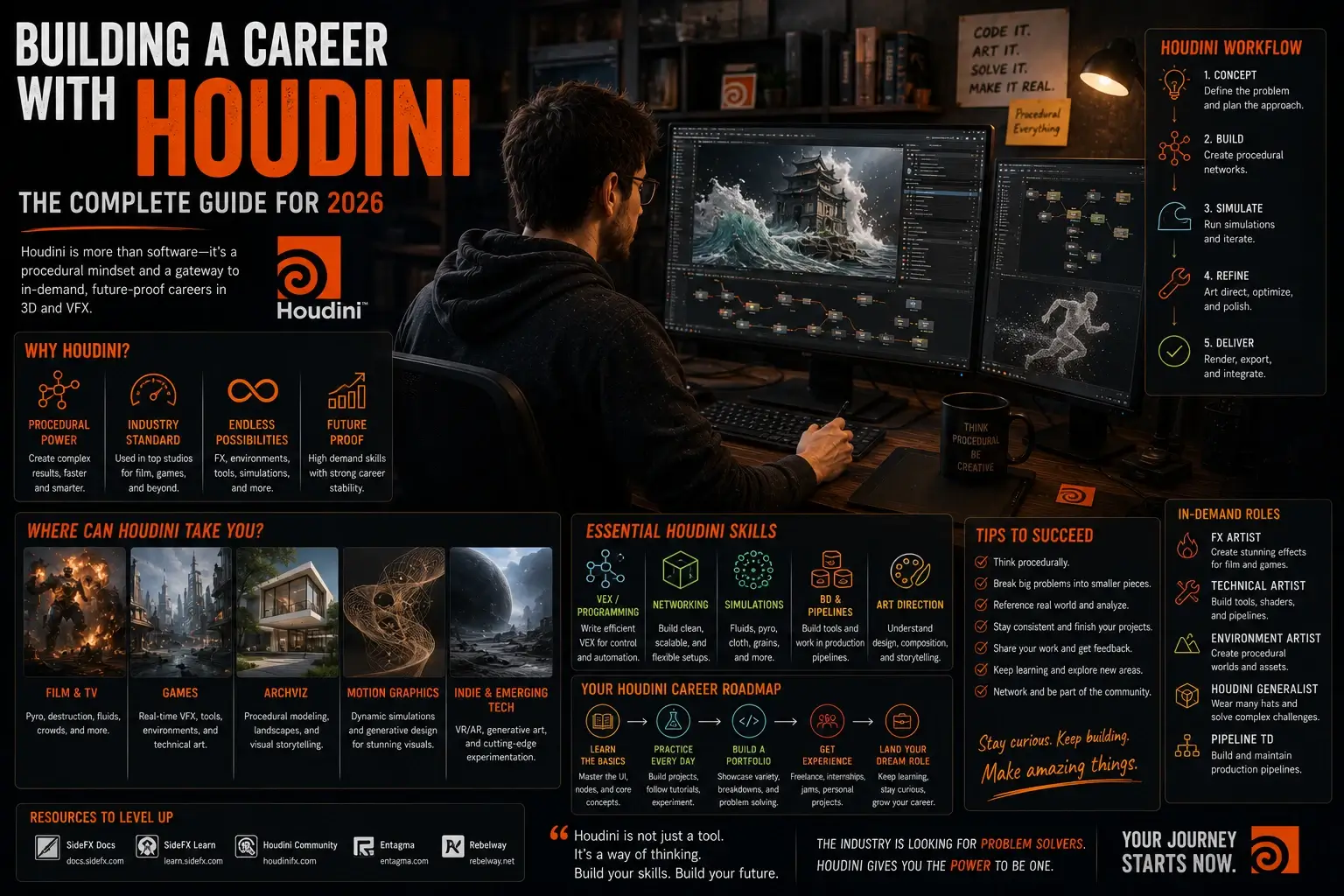
Houdini has established itself as one of the most powerful and most in-demand tools in the VFX and animation industries. What began as a procedural 3D animation system has evolved into the industry standard for effects simulation, procedural content generation, and technical pipeline work across film, television, games, and advertising. For artists and technical directors who invest in developing genuine Houdini expertise, the career opportunities — and the compensation — are exceptional. This guide covers what a Houdini career looks like, which roles require it, how to learn it effectively, and how to build a portfolio that gets you hired.
If you are ready to explore current opportunities for Houdini artists, browse VFX and post-production jobs on PixelCareer.
Why Houdini Is So Valuable in the Industry
Houdini’s value comes from its procedural, node-based approach to 3D content creation. Unlike traditional 3D software where you directly manipulate geometry and set keyframes, Houdini builds everything from networks of nodes that define how geometry is created, transformed, and simulated. This procedural approach produces several advantages that make it uniquely valuable in production:
Non-destructive workflows: Because every operation is defined by a node rather than directly applied to geometry, changes can be made at any point in the network without destroying downstream work. This makes iteration — which is the reality of production, where nothing is right the first time — dramatically more efficient.
Scalability: Procedural systems can be applied to objects of any complexity with minimal additional work. A destruction simulation built for a small building can be scaled to an entire city block by adjusting parameters rather than rebuilding the setup from scratch.
Simulation quality: Houdini’s fluid, rigid body, cloth, crowd, and particle simulation systems are among the most sophisticated available in any commercial software. The physical accuracy and visual quality achievable in Houdini simulations is why it dominates film and high-end games VFX.
Pipeline integration: Houdini’s Python scripting capabilities and its USD (Universal Scene Description) support make it a central tool in modern VFX pipelines, with strong integration into render engines like Mantra, Karma, Arnold, and RenderMan, and into games engines via Houdini Engine.
Roles That Use Houdini
FX Artist / Houdini FX Artist: The most directly Houdini-focused role. FX artists use Houdini to create dynamic effects — explosions, fire, water, smoke, dust, cloth, and destruction simulations. This is one of the highest-demand and best-compensated specialisations in VFX, with experienced FX artists in consistent demand across film, TV, and games productions.
Procedural Environment Artist: Uses Houdini’s geometry processing and procedural modelling capabilities to create environments — terrain, cities, forests, and complex natural formations — at a scale and with a level of variation that would be impossible to create by hand. Games studios and VFX houses both hire for this specialisation.
Rigging and Character TD: Houdini’s KineFX system has made it an increasingly viable tool for character rigging and technical animation work, particularly for creatures with complex deformation requirements.
Pipeline Technical Director: Houdini’s scripting capabilities and deep Python integration make it a powerful pipeline tool. Technical directors who can build and maintain Houdini-based pipelines are in demand at larger studios where production complexity requires custom tooling.
Games Technical Artist: Houdini Engine allows Houdini tools to run inside game engines including Unreal and Unity, enabling procedural content generation workflows in games development. Technical artists who can build Houdini Digital Assets for use in game engine pipelines are increasingly sought after at games studios of all sizes.
How to Learn Houdini Effectively
Houdini is widely considered one of the most challenging tools to learn in the creative industry. Its node-based, procedural approach requires a fundamental shift in how you think about 3D work — away from directly manipulating objects and toward building systems that generate the results you want. This learning curve is also part of what makes Houdini expertise so valuable — fewer artists develop it, which increases the demand for those who do.
The most effective approach to learning Houdini:
Start with the fundamentals of procedural thinking. Before attempting complex simulations, understand how Houdini’s node networks work — how data flows through the network, what SOPs (Surface Operators) do, and how to read and debug a node graph. SideFX’s official tutorials at sidefx.com/learn are an excellent starting point and are regularly updated.
Focus on one specialisation at a time. Houdini covers an enormous range of capabilities. Trying to learn everything simultaneously produces shallow knowledge across too many areas. Choose one specialisation — pyro simulations, fluid simulations, rigid body destruction, or procedural modelling — and develop genuine depth in that area before expanding.
Follow structured learning resources. Beyond SideFX’s official tutorials, resources like Applied Houdini, CGMA’s Houdini courses, and Rebelway cover production-level Houdini techniques across multiple specialisations. Investing in structured learning significantly accelerates development compared to learning purely from scattered online tutorials.
Recreate real production work as exercises. Identify VFX shots from films or games that demonstrate the specialisation you are developing and attempt to recreate them. This forces you to solve real production problems and produces portfolio pieces that demonstrate production-relevant skills rather than tutorial results.
Join the Houdini community. The Houdini community on Discord, Reddit, and the SideFX forums is large, technically sophisticated, and generally helpful. Sharing your work and asking specific questions accelerates learning and builds professional visibility within the community.
Building a Houdini Portfolio
A Houdini portfolio is different from a standard art portfolio in several important ways. Studios hiring Houdini artists are not just evaluating the visual quality of your renders — they want to see your simulation setups, understand your node graphs, and verify that you are genuinely building the effects yourself rather than relying on preset systems.
Essential elements of a strong Houdini FX portfolio:
- A reel of three to five high-quality shots showcasing your best work — lead with your most impressive effect
- Breakdown videos for each shot showing your node network, simulation setup, and the before/after progression
- Render quality that is production-ready — your final renders should demonstrate that you understand lighting, shading, and compositing as well as simulation
- Variety that demonstrates range — fluid, pyro, destruction, and cloth simulations show broader capability than multiple variations of the same effect type
- Clear labelling of which software was used for each element — Houdini for simulation, Maya for integration, Nuke for compositing
Houdini Artist Salaries in 2026
Houdini expertise is among the highest-compensated specialisations in the VFX industry, reflecting both the difficulty of developing the skill and the critical role FX work plays in high-profile productions.
- Junior Houdini FX Artist (US): $55,000 – $80,000 per year
- Mid-Level Houdini FX Artist (US): $80,000 – $120,000 per year
- Senior Houdini FX Artist (US): $120,000 – $160,000 per year
- FX Lead / Supervisor (US): $150,000 – $200,000+ per year
In the UK, equivalent ranges are approximately £35,000 – £50,000 at junior level, £50,000 – £80,000 at mid-level, and £80,000 – £120,000 at senior level. Freelance Houdini FX artists can command day rates of £400 – £900 in the UK and $600 – $1,400 in the US depending on experience and the complexity of work required.
Frequently Asked Questions
How long does it take to become proficient in Houdini?
Reaching a junior production-ready level typically takes one to two years of focused, consistent learning. Reaching senior-level expertise takes five or more years of professional experience across diverse production types. The learning curve is steep initially — many artists find the first few months particularly challenging — but the investment compounds significantly as your understanding of procedural thinking deepens.
Do I need programming skills to use Houdini professionally?
Basic Python scripting is increasingly expected for professional Houdini work, particularly in pipeline and technical director roles. For FX artist roles, strong node-based problem solving is more important than programming ability — but VEX (Houdini’s expression language) and Python both become valuable as you develop beyond junior level.
Is Houdini used in games as well as film?
Yes — Houdini’s presence in games has grown significantly through Houdini Engine, which allows procedural tools built in Houdini to run inside Unreal Engine and Unity. Games studios use Houdini for environment generation, destruction simulations, and technical art workflows. The games Houdini market is smaller than the film market but growing rapidly.
What computer do I need to learn Houdini?
Houdini’s simulation work is computationally demanding. A modern workstation with a powerful CPU, 32GB or more of RAM, and a capable GPU for viewport performance and GPU rendering will handle most learning and portfolio work. Professional production typically uses dedicated render farms, but a capable personal workstation is sufficient for developing skills and producing portfolio pieces.
Is there a free version of Houdini for learning?
Yes — SideFX offers Houdini Apprentice, a free non-commercial version with full functionality for learning. It adds a watermark to renders and cannot be used for commercial work, but is entirely sufficient for developing skills and building a portfolio. Houdini Indie is available at a significantly reduced cost for artists earning below a commercial threshold.
Final Thoughts
Houdini expertise is one of the most rewarding and most valuable specialisations you can develop in the VFX and technical art industries. The learning curve is genuinely challenging — but the career opportunities, compensation, and creative scope available to experienced Houdini artists are exceptional. Studios consistently report difficulty finding experienced Houdini FX artists, which keeps demand and compensation strong for those who have invested the time to develop genuine proficiency.
Start with the fundamentals, focus on one specialisation, build a portfolio that demonstrates your process as well as your results, and stay engaged with the community as you develop. The investment is significant — and the return on that investment is exceptional.
Ready to find your next Houdini or VFX role? Browse VFX and post-production jobs on PixelCareer.