
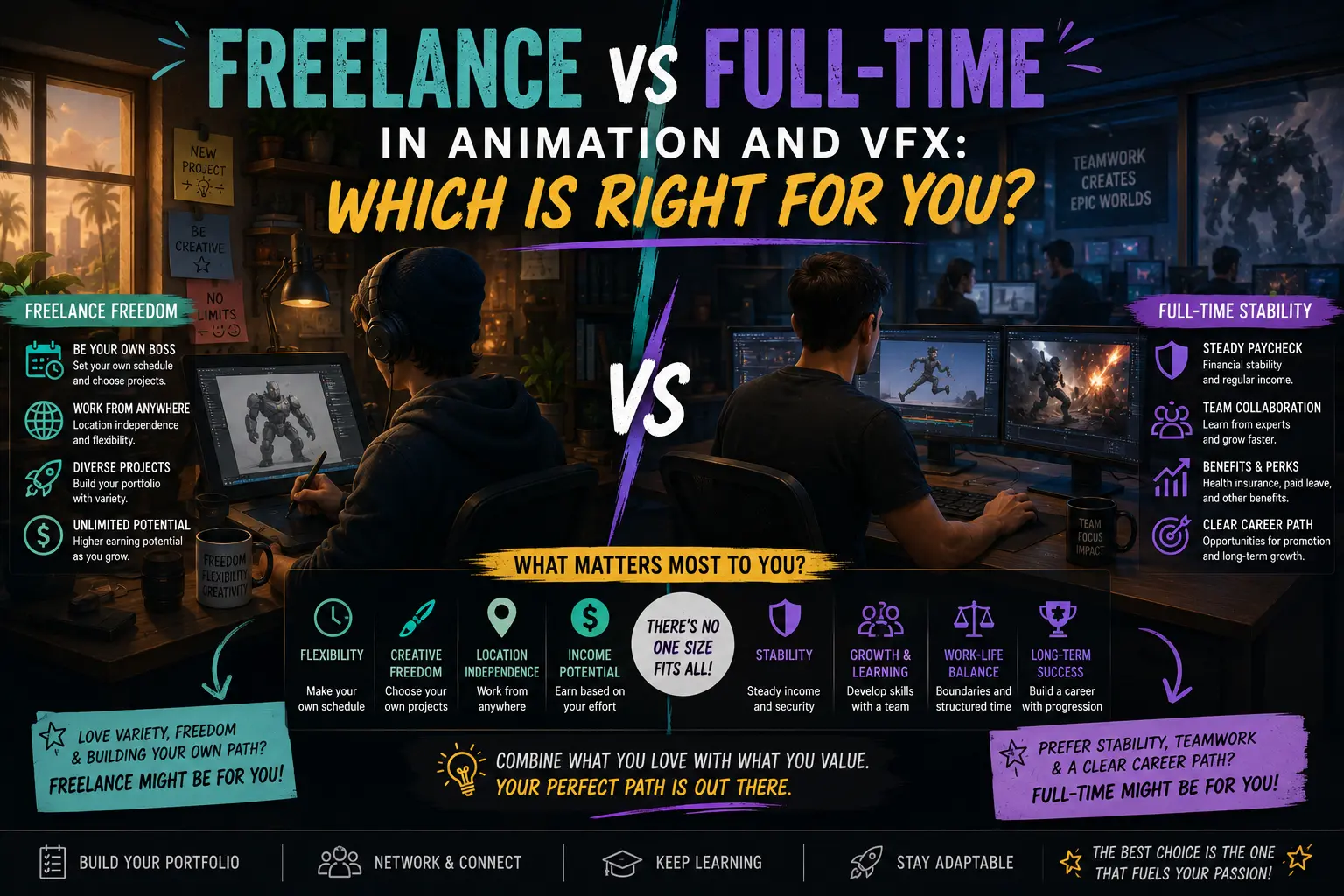
One of the most significant career decisions a creative professional faces is whether to pursue freelance work or full-time studio employment. In animation, VFX, motion design, and games, both paths are genuinely viable — and both come with real advantages and real trade-offs. The right choice depends on your financial situation, career stage, personal working style, and long-term goals. There is no universally correct answer, but there is almost certainly a better answer for where you are right now.
This guide covers the key differences between freelance and full-time work in the creative industry — including income, stability, career progression, creative freedom, and practical considerations — so you can make a more informed decision about which path to pursue. If you are exploring full-time opportunities, you can browse creative industry jobs on PixelCareer to see what is currently available.
How the Creative Industry Uses Both Models
The animation, VFX, and motion design industries have always relied heavily on a mix of permanent staff and freelance contractors. This is partly structural — productions are project-based, and studios scale their teams up and down depending on the volume of work in their pipeline — and partly cultural, reflecting the high proportion of creative professionals who prefer the autonomy and variety that freelance work provides.
Understanding how studios use each model helps you position yourself effectively regardless of which path you choose:
Full-time employees are typically core team members — leads, supervisors, and specialists whose knowledge of the studio’s pipeline and culture makes them valuable across multiple productions. They provide continuity, institutional knowledge, and consistent availability.
Freelancers are brought in to meet production demand during peak periods, to fill specialist skill gaps, or to supplement core teams on large projects. Experienced freelancers with strong reputations can build extremely consistent workflows — often working with the same studios on repeat engagements.
Both models exist at every level of the industry, from junior to director level. Neither is inherently more prestigious or more secure than the other — the reality of each depends entirely on the individual and the market conditions at any given time.
Income: Freelance vs Full-Time
Income is one of the most important practical differences between the two paths, and it is more complex than the headline rates suggest.
Full-Time Salary
Full-time employees receive a predictable salary, typically paid monthly or bi-weekly, along with a benefits package that in most markets includes health insurance, pension contributions, paid leave, and sometimes equity or profit sharing. The stability of a fixed salary makes financial planning straightforward and removes the anxiety of income variability.
The trade-off is that your earning potential is capped by your salary band. Progression typically requires a promotion, a performance review, or a move to a different studio. Annual raises are common but rarely dramatic.
Freelance Day Rates
Freelancers typically charge a day rate rather than an annual salary. Day rates in animation, VFX, and motion design vary significantly by discipline, experience, and market:
- Junior freelance animator or motion designer: £200 – £350 per day (UK) / $300 – $500 per day (US)
- Mid-level freelance animator or VFX artist: £350 – £550 per day (UK) / $500 – $800 per day (US)
- Senior freelance specialist: £550 – £900 per day (UK) / $800 – $1,400 per day (US)
At first glance, freelance day rates appear dramatically higher than equivalent full-time salaries. A mid-level animator earning £400 per day could theoretically earn £96,000 if they worked 240 days per year — significantly above the full-time equivalent. However, this comparison requires important caveats.
Freelancers do not work 240 billable days per year. Time spent finding work, managing finances, handling admin, and between engagements is unbillable. A realistic utilisation rate for an experienced freelancer in a strong market might be 180 to 210 billable days per year. Freelancers also carry costs that full-time employees do not — accountancy fees, professional insurance, software licences, equipment, and in most countries self-employment tax obligations that differ from PAYE employment. When these are factored in, the income advantage of freelancing is real but considerably smaller than the headline day rate suggests.
Stability and Security
The stability question is where the two paths diverge most sharply — and where personal risk tolerance matters most.
Full-time employment offers predictable income, notice periods before termination, statutory redundancy protections in most markets, and the security of knowing what you will earn each month. This stability has real value, particularly for people with financial commitments like mortgages, family dependents, or significant regular outgoings.
Freelancing means that your income is directly tied to your ability to find and win work consistently. In a strong market with high demand for your skills, this is rarely a problem for experienced practitioners. In a slow market — or during a period when you are changing your focus or recovering from a quiet patch — income can drop significantly or disappear entirely. Freelancers need an emergency fund equivalent to three to six months of living expenses to manage income variability comfortably.
It is worth noting that full-time employment in the creative industry is not as stable as employment in some other sectors. Studios are acquired, productions are cancelled, and redundancies are a regular feature of the industry landscape. Full-time employees have more legal protections than freelancers, but they are not immune to job loss. Many experienced creative professionals consider a strong freelance network to be a more reliable source of long-term income security than dependence on a single employer.
Creative Freedom and Variety
For many creative professionals, the appeal of freelancing is less about income and more about the variety of work and the degree of creative autonomy it offers.
Freelancers work across multiple studios, agencies, and clients over the course of a year. This variety exposes you to different pipelines, working cultures, creative approaches, and project types — and it tends to accelerate skill development significantly. You also have the ability to decline work that does not interest you and to pursue projects that align with your creative ambitions, within the constraints of what the market is offering.
Full-time employees work within the constraints of their studio’s pipeline and production slate. On a long production, you may spend months or years focused on a narrow set of tasks within a specific project. This depth of focus can produce exceptional specialist expertise — but it can also feel limiting if the production is not engaging or if you are more creatively motivated by variety.
The creative freedom argument favours freelancing, particularly for mid-to-senior professionals who have a clear sense of the type of work they want to do. For junior professionals who are still developing their skills and building their knowledge of the industry, the structured environment and mentorship available in a full-time role often provides more value than the variety of freelancing.
Career Progression
Career progression looks different on each path, and neither offers a straightforward route to senior and lead roles.
Full-time progression typically follows a defined ladder — junior, mid, senior, lead, supervisor — with promotions tied to performance reviews, production milestones, and internal availability. The advantage is visibility: your leads and supervisors see your work daily and are in a position to advocate for your promotion when the opportunity arises. The disadvantage is that progression timelines are partly determined by factors outside your control — budget, headcount, and internal politics all play a role.
Freelance progression is less linear and more reputation-driven. You advance by building a track record of quality work, developing a strong professional network, and consistently winning more complex and better-paid engagements. There are no formal promotions — your seniority is signalled by your day rate, the studios you work for, and the complexity of the projects you are brought in to work on.
Moving into lead or supervisory roles is generally easier from a full-time position, where you have the daily visibility and the opportunity to demonstrate leadership over time. Freelance leads and supervisors exist but typically have built their reputation over many years across a wide range of high-profile productions.
Work-Life Balance and Flexibility
Flexibility is one of the most frequently cited reasons creative professionals choose freelancing — but the reality is more nuanced than it initially appears.
Freelancers have the ability to take time off between engagements, to work remotely more easily, and to structure their working patterns around their personal lives to a greater degree than most full-time employees. This flexibility is real and valuable — but it comes with the caveat that turning down work during slow periods or during critical career-building phases can have meaningful consequences for your income and your reputation.
Full-time employees in the creative industry often work long hours during production crunches. This is a genuine issue, particularly in games and film, where crunch culture — while increasingly challenged — remains present at many studios. That said, post-2020 improvements in remote working policies, four-day work week experiments, and anti-crunch commitments from some studios have improved the full-time work-life balance picture in parts of the industry.
Getting Started: Which Path Makes Sense at Each Career Stage
Early career (0 to 3 years): Full-time employment is generally the better starting point. The structured environment, mentorship, and pipeline experience of a studio role accelerates skill development in ways that are difficult to replicate independently. Building your first professional credits in a full-time role gives you the foundation that makes freelancing viable and lucrative later.
Mid career (3 to 7 years): This is when many creative professionals first consider freelancing seriously. With several years of professional experience, a growing network, and a strong portfolio, the market conditions for freelancing are significantly better than at entry level. Some professionals transition to freelancing at this stage; others remain full-time and move into lead roles. Both are valid choices.
Senior career (7 years plus): At senior level, the financial case for freelancing is strongest. Senior specialists with strong reputations and established networks can achieve excellent day rates and consistent work across high-profile productions. Many senior creative professionals move fluidly between freelance and full-time arrangements throughout their careers, taking staff roles for particular productions or studios and returning to freelancing between engagements.
Frequently Asked Questions
Can you switch between freelance and full-time throughout your career?
Yes — and many creative professionals do exactly this. It is common to move between freelance and full-time employment multiple times over the course of a career, depending on personal circumstances, market conditions, and the opportunities available. A strong professional network and an up-to-date portfolio make these transitions significantly easier.
Do freelancers in animation and VFX need to register as a business?
In most markets, yes. Freelancers typically need to register as self-employed or operate through a limited company, depending on the jurisdiction and the volume of their earnings. The specifics vary significantly by country — consulting a local accountant who works with creative industry freelancers is strongly recommended before you start taking on freelance work.
Is it harder to get a mortgage as a freelancer?
Mortgage applications can be more complex for freelancers than for full-time employees, as lenders typically require two to three years of self-employed accounts rather than a straightforward payslip. This is a manageable challenge rather than an insurmountable barrier, but it is worth factoring into your financial planning if homeownership is a near-term goal.
How do you find freelance work in animation and VFX?
The most reliable sources of freelance work are professional networks built over time — former colleagues, studio contacts, and referrals from other freelancers. Job boards and platforms like PixelCareer’s freelance job listings are also a useful source, particularly when you are building your network or entering a new market. Maintaining an active, up-to-date portfolio and LinkedIn profile ensures you are visible to studios actively looking for freelancers.
What is the biggest mistake people make when going freelance?
The most common mistake is going freelance too early — before building sufficient experience, a strong enough portfolio, and a large enough professional network to generate consistent work. The second most common mistake is underpricing. Many new freelancers set their day rate too low in an attempt to win work, which undervalues their skills and makes it difficult to raise rates later. Research market rates carefully and price at a level that reflects your actual skill and experience.
Final Thoughts
There is no universally correct answer to the freelance versus full-time question in the creative industry. Both paths can lead to fulfilling, well-compensated careers — the best choice is the one that fits your current circumstances, your financial needs, your working style, and your long-term goals.
If you are early in your career, the structure and mentorship of full-time employment will almost certainly serve you better than the independence of freelancing. If you are mid-to-senior level with a strong network and portfolio, the financial and creative case for freelancing becomes much more compelling.
Whatever path you are on, the fundamentals remain the same — produce excellent work, build genuine relationships, and keep developing your skills. Those things drive career success on both sides of the employment equation.
If you are looking for your next opportunity — full-time or freelance — browse current creative industry jobs on PixelCareer and find roles that match where you are in your career.