
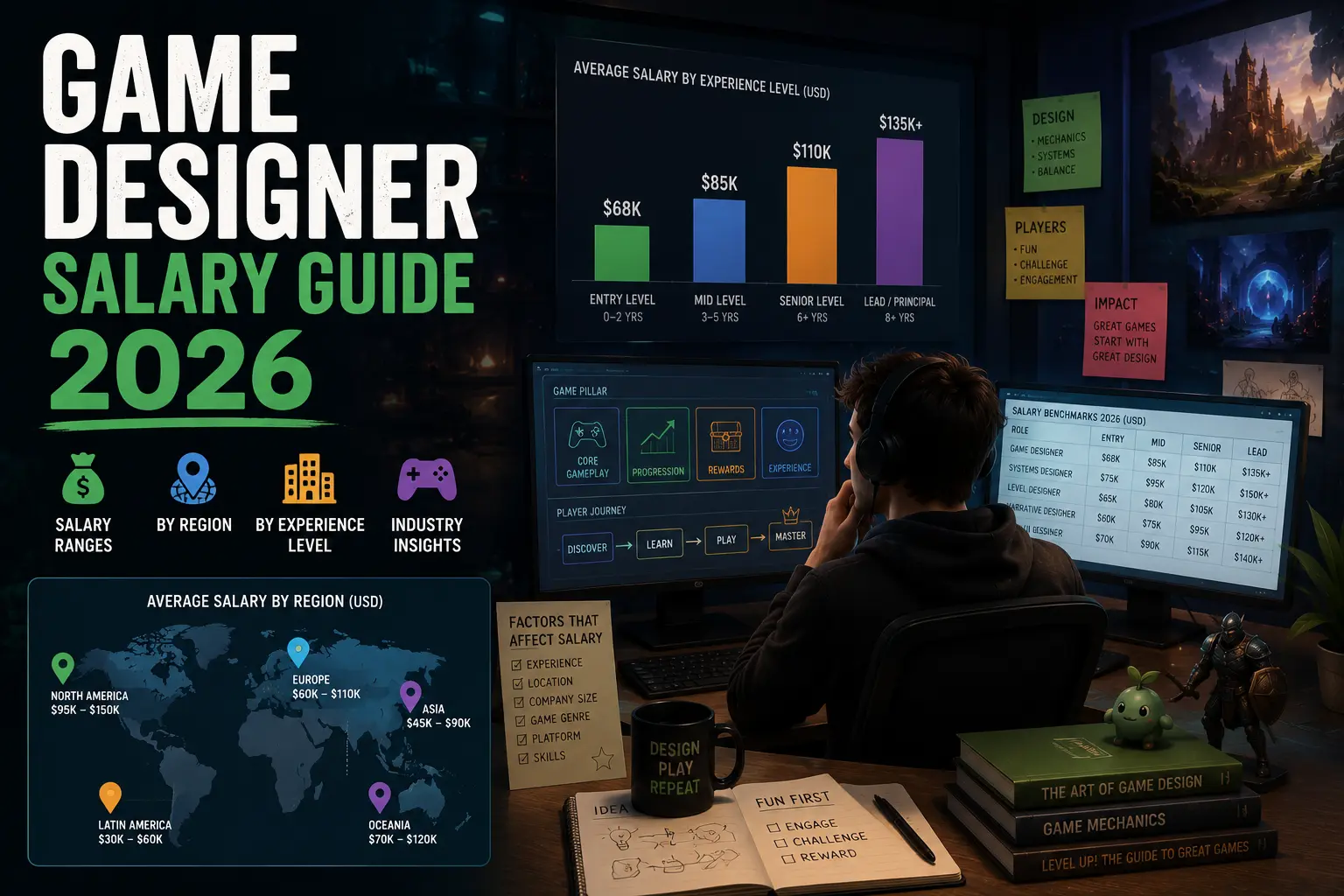
Game design is one of the most sought-after careers in the games industry — and one of the most varied when it comes to compensation. A junior game designer at a small indie studio and a senior game designer at a AAA publisher can earn vastly different salaries, even with similar levels of experience. Understanding what game designers actually earn in 2026, and what factors drive those differences, is essential whether you are negotiating your first offer, planning your next career move, or simply benchmarking your current salary against the market.
This guide breaks down game designer salaries by experience level, location, studio size, and specialisation — giving you a realistic picture of what to expect at every stage of your career. If you are ready to explore current opportunities, you can browse game designer jobs on PixelCareer.
Game Designer Salary Overview for 2026
Across the games industry globally, game designer salaries in 2026 range broadly depending on experience, location, and employer. Here is a high-level overview of typical annual salary ranges:
- Junior Game Designer: $45,000 – $70,000 USD
- Mid-Level Game Designer: $70,000 – $100,000 USD
- Senior Game Designer: $100,000 – $140,000 USD
- Lead Game Designer: $130,000 – $170,000 USD
- Principal / Director of Design: $160,000 – $220,000+ USD
These figures represent base salary in US dollars and reflect the broader global market. Actual compensation varies significantly based on geography, studio size, and the specific type of design role. We cover each of these factors in detail below.
Junior Game Designer Salary
Junior game designers typically have zero to three years of professional experience. At this stage, salaries reflect the entry-level nature of the role while still acknowledging the specialised skills required to work in a professional game development environment.
Typical junior game designer salary ranges by region:
- United States: $48,000 – $72,000 per year
- United Kingdom: £28,000 – £40,000 per year
- Canada: $55,000 – $75,000 CAD per year
- Australia: $60,000 – $80,000 AUD per year
- Germany: €38,000 – €52,000 per year
Junior roles at larger AAA studios tend to sit at the higher end of these ranges, while small indie studios and mobile game companies often pay at the lower end. Benefits, bonuses, and profit-sharing arrangements can add meaningfully to base compensation at larger employers.
Mid-Level Game Designer Salary
Mid-level game designers typically have three to six years of professional experience and are expected to work with significant independence on complex design problems. At this level, compensation increases reflect both expanded responsibility and the difficulty studios face in finding experienced designers.
Typical mid-level game designer salary ranges by region:
- United States: $72,000 – $105,000 per year
- United Kingdom: £42,000 – £58,000 per year
- Canada: $78,000 – $100,000 CAD per year
- Australia: $82,000 – $105,000 AUD per year
- Germany: $54,000 – $72,000 EUR per year
At this career stage, specialisation starts to meaningfully affect salary. A mid-level systems designer at a major RPG studio will typically earn more than a mid-level level designer at a smaller studio, even with identical years of experience.
Senior Game Designer Salary
Senior game designers are among the most valued contributors on a development team. With six or more years of experience, they handle the most complex design challenges, mentor junior team members, and contribute to high-level creative decisions. This is reflected in substantially higher compensation.
Typical senior game designer salary ranges by region:
- United States: $105,000 – $145,000 per year
- United Kingdom: £58,000 – £80,000 per year
- Canada: $105,000 – $135,000 CAD per year
- Australia: $105,000 – $130,000 AUD per year
- Germany: €68,000 – €88,000 per year
Senior game designers at major US publishers — particularly those based in California — frequently earn above these ranges when stock options, annual bonuses, and other forms of equity compensation are included. If you are targeting senior roles, you can view senior game designer positions on PixelCareer.
Lead and Director-Level Game Designer Salary
Lead game designers manage a team of designers and take ownership of entire design systems or game areas. Director-level roles carry studio-wide or franchise-wide creative responsibility. Compensation at these levels increases significantly and often includes equity, profit sharing, and performance bonuses in addition to base salary.
- Lead Game Designer (US): $130,000 – $175,000 base salary
- Design Director (US): $160,000 – $220,000+ base salary
- Creative Director (US): $180,000 – $280,000+ base salary
These roles are typically not advertised openly — they are filled through internal promotion or direct recruitment from candidates with strong industry reputations. Building visibility in the industry through shipped titles, conference talks, and professional networks is the most reliable path to these positions.
How Specialisation Affects Game Designer Salary
Game design is not a single discipline. Different specialisations command meaningfully different salaries, reflecting the relative scarcity of expertise and the commercial value each brings to a production.
Systems Designer: Systems designers build the underlying mechanics and economy of a game. This role requires analytical thinking and often a strong understanding of data and player behaviour. Systems designers are among the highest-paid designers at any level, particularly in live service and mobile games where economy design directly impacts revenue.
Level Designer: Level designers create the spatial environments players navigate. Strong level designers with shipped AAA titles command solid salaries, though the role is generally compensated slightly below systems design at equivalent experience levels.
Narrative Designer: Narrative designers create the story structure, dialogue, and branching scripts that drive game narratives. Salaries are comparable to level design, though senior narrative designers with strong writing portfolios can command premium compensation at story-driven studios.
UX Designer: UX designers focus on the player experience from an interface and usability perspective. This role bridges game design and product design, and UX designers with games experience are in high demand across both traditional studios and tech companies building gaming products.
Technical Designer: Technical designers operate at the intersection of design and programming, often working directly with game engines to implement and prototype systems. This specialisation consistently commands some of the highest salaries in the design discipline due to the dual skill set required.
How Studio Size and Type Affects Compensation
The type of studio you work for has a major impact on total compensation — sometimes as significant as the difference between seniority levels.
AAA Studios and Major Publishers: Companies like Electronic Arts, Activision Blizzard, Ubisoft, and Take-Two Interactive offer the highest base salaries in the industry, along with comprehensive benefits packages, annual bonuses, and in some cases equity. The trade-off is often larger teams, more specialised roles, and longer production cycles.
Mid-Sized Studios: Studios with 100 to 500 employees typically offer salaries 10 to 20 percent below major publishers, but often provide more creative ownership, faster career progression, and a stronger sense of individual contribution to the final product.
Indie Studios: Salaries at small indie studios are typically the lowest in the industry, often 20 to 40 percent below AAA equivalents. However, indie roles frequently offer profit sharing arrangements, significant creative freedom, and the opportunity to ship a complete game quickly — all of which have real career value beyond the base salary figure.
Mobile and Social Games: Mobile games companies — particularly those with successful live service titles — can offer salaries comparable to or exceeding AAA console studios, especially for systems designers and economy designers whose work directly drives monetisation.
Location and Remote Work Salaries
Geography remains one of the most significant factors in game designer compensation. Studios based in San Francisco, Los Angeles, Seattle, and New York consistently pay above the national US average due to local cost of living and competition for talent.
The rise of remote work in the games industry has introduced more complexity to this calculation. Many studios now offer remote-friendly or fully remote positions, but compensation policies vary significantly:
- Some studios pay a single rate regardless of location
- Others adjust salary based on the cost of living in your location
- A smaller number use location-based salary bands that reduce pay for candidates outside major cities
When evaluating remote roles, always clarify the studio’s compensation policy relative to your location before accepting an offer.
Benefits and Total Compensation
Base salary is only part of the picture. The most competitive game design jobs offer a range of additional compensation and benefits that can significantly increase total remuneration:
- Annual performance bonuses: Common at AAA studios, typically 5 to 15 percent of base salary
- Royalty or profit sharing: Common at mid-sized and indie studios for senior contributors
- Stock or equity: Offered at publicly listed publishers and some venture-backed studios
- Health insurance: Standard in the US; statutory in most European markets
- Remote work allowance: Increasingly common — equipment, internet, and home office stipends
- Professional development budget: Training, conferences, and software licences
- Flexible working arrangements: Four-day weeks and flexible hours are becoming more common post-2020
How to Negotiate a Game Designer Salary
Salary negotiation is a normal and expected part of the hiring process in the games industry. Studios build negotiation room into their initial offers — the first number you receive is rarely the final number available.
Before negotiating, research comparable salaries using resources like Glassdoor, LinkedIn Salary, and industry surveys from the Game Developers Conference. Having data behind your request makes negotiation more productive and less uncomfortable.
Practical negotiation tips for game designers:
- Let the studio make the first offer where possible — avoid anchoring low by naming a number first
- Negotiate on total compensation, not just base salary — bonuses, remote work, and professional development budgets all have monetary value
- Be specific about your market research — “Based on comparable roles in this market, I was expecting closer to X” is more effective than a general request for more
- If the base salary cannot move, ask about other elements — signing bonus, earlier performance review, or additional leave
Frequently Asked Questions
What is the average game designer salary in the United States?
The average game designer salary in the US in 2026 sits around $85,000 to $95,000 per year across all experience levels. Junior designers typically earn $48,000 to $72,000, mid-level designers earn $72,000 to $105,000, and senior designers earn $105,000 to $145,000. Location, studio size, and specialisation all affect where you fall within these ranges.
Do game designers earn more than programmers?
Generally, programmers — particularly technical and engine programmers — earn more than game designers at equivalent experience levels. However, the gap narrows significantly for technical designers and senior or director-level design roles. Systems designers and UX designers with strong technical skills also command salaries closer to programming compensation.
Is game design a well-paying career?
Game design is a well-paying career, particularly at mid-level and above. Entry-level salaries are modest relative to the cost of living in major game development hubs like San Francisco or London, but compensation grows significantly with experience. Senior and lead designers at major studios earn salaries that are competitive with most other creative industries.
What game design specialisation pays the most?
Technical designers and systems designers consistently earn the most within the game design discipline, due to the combination of technical and creative skills required. UX designers with games industry experience are also among the higher earners, particularly at studios where player retention and engagement are core business metrics.
How do I increase my game designer salary?
The most effective ways to increase your game designer salary are: shipping titles that demonstrate your impact, developing a rare specialisation such as technical design or systems design, moving to a larger studio or higher cost-of-living market, and negotiating proactively rather than accepting initial offers. Visibility in the industry — through shipped work, talks, and professional networks — also opens doors to higher-paying roles that are rarely advertised publicly.
Final Thoughts
Game designer salaries in 2026 reflect a maturing industry that increasingly values skilled designers as core contributors to commercial success. Entry-level salaries remain modest in many markets, but compensation grows meaningfully with experience, specialisation, and the quality of titles you have shipped.
Understanding where you stand relative to the market is the first step to being paid fairly. Research thoroughly, negotiate confidently, and focus on developing the specialised skills that command premium compensation at every level of your career.
If you are looking for your next game design role, browse game design and gaming jobs on PixelCareer and find opportunities at studios worldwide.