
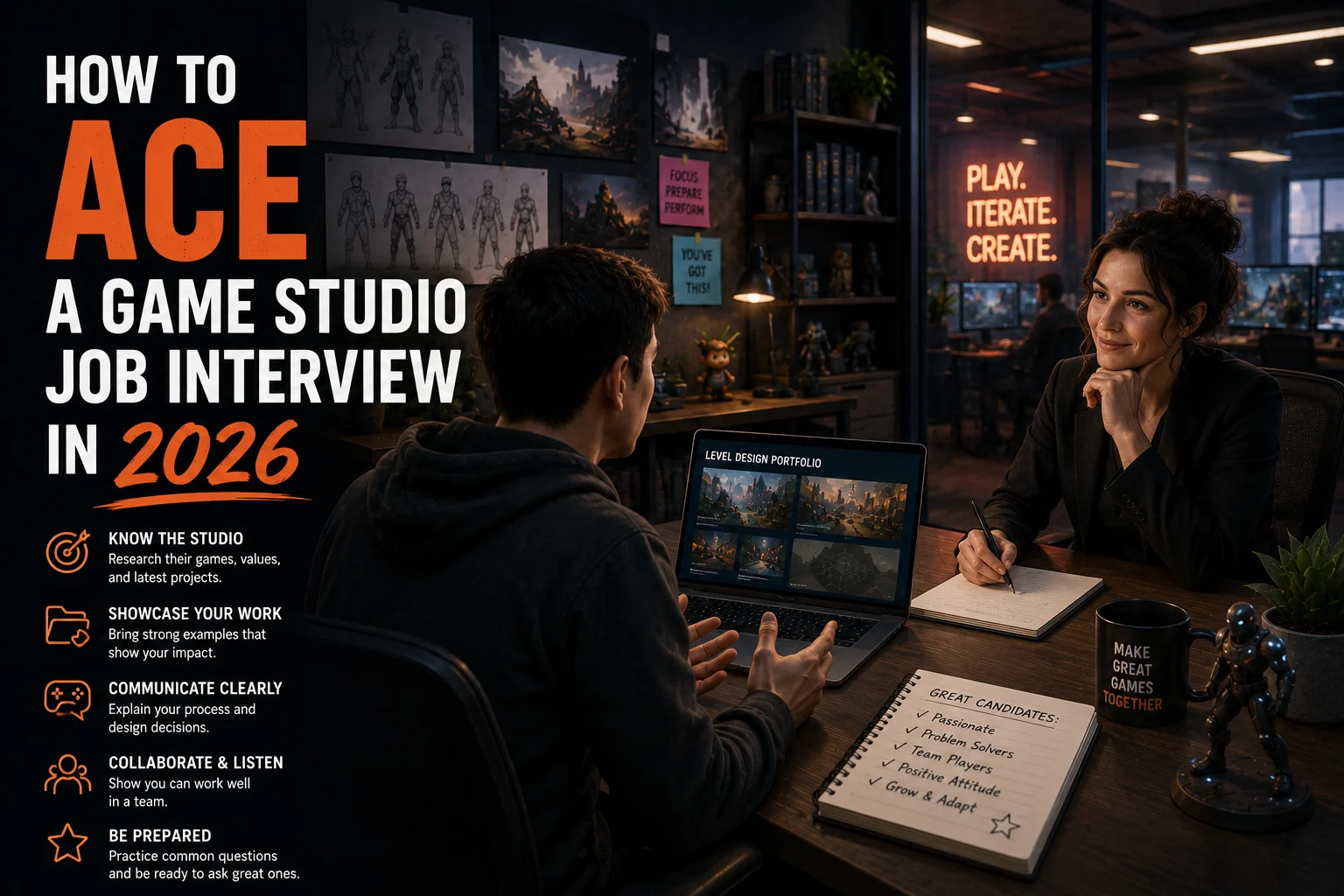
Landing an interview at a game studio is a significant achievement — but getting through the interview and receiving an offer is where the real work begins. Game studio interviews test your creative thinking, technical knowledge, problem-solving ability, and cultural fit — often simultaneously, across multiple rounds spanning several weeks. Browse current game studio job openings on PixelCareer to find roles worth targeting.
Understanding the Game Studio Interview Process
Stage 1 — Portfolio Review: Your application and portfolio are reviewed. Quality and relevance of your portfolio is the primary filter.
Stage 2 — Screening Call: 20 to 45 minutes covering your background, experience, and interest in the role.
Stage 3 — Art Test or Technical Assessment: A practical test — art test for creative roles, coding test for technical roles, design exercise for game design. Typically the most significant filter.
Stage 4 — Technical or Craft Interview: Deeper conversation with senior team members focused on your discipline, process, tool knowledge, and production experience.
Stage 5 — Cultural and Team Fit Interview: How you work with others, handle feedback, manage conflict, and whether your values align with the studio’s culture.
Stage 6 — Offer: Negotiation is expected and normal at this stage.
Preparing Your Portfolio for the Interview
For every significant piece, be prepared to discuss: what the brief was, what tools and techniques you used, what challenges you encountered and resolved, what you would do differently today, and your specific contribution if collaborative. Interviewers evaluate your thought process and self-awareness as much as the finished work.
The Art Test — How to Approach It
Read the brief carefully and completely before starting. Manage your time explicitly — a complete submission addressing all requirements at a good standard beats a partially completed submission with one exceptional element. Document your process. Deliver on time. Polish the deliverable — clean files, clear naming, professional presentation.
Common Technical Interview Questions
Animation
- How do you approach a complex character performance shot from start to finish?
- How do you handle feedback you disagree with creatively?
- What is your process for blocking — stepped or splined?
- What are the 12 principles of animation and which are most relevant to your work?
VFX and Technical Roles
- Walk me through your approach to a complex simulation setup.
- How do you optimise a shot running over its render budget?
- What scripting or programming languages do you use regularly?
Game Design
- Walk me through the design of a mechanic you are particularly proud of.
- Tell me about a design decision that turned out to be wrong — what did you learn?
- Pitch a new game mechanic for one of our existing titles.
Behavioural Interview Questions
Use the STAR method: Situation, Task, Actions, Result. Common questions include: Tell me about a time you received critical feedback. Describe a situation where you collaborated with someone whose working style differed from yours. Give an example of a time you had to learn a new skill quickly under production pressure.
Questions to Ask the Studio
- What does success look like in this role in the first six months?
- How does the team approach creative disagreements between artists and leads?
- What are the biggest technical or creative challenges the team is currently working through?
- How does the studio approach professional development?
Frequently Asked Questions
How long does a game studio interview process take?
Small studios may complete the process in two to three weeks. Large studios can take four to eight weeks. If you have another offer with a deadline, communicate this transparently.
What should I wear to a game studio interview?
Game studios are almost universally casual environments. Smart casual is appropriate — clean, presentable clothing that is professional without being overly formal.
Is it normal to fail an art test at a top studio?
Yes — art tests at top studios are genuinely difficult. A failed art test is not necessarily a reflection of your talent — it may reflect your development relative to the studio’s current quality bar. Request feedback and use it to grow.
Can I negotiate salary after a game studio offer?
Absolutely — and you should. Studios build negotiation room into initial offers. Consider the full package — base salary, bonus, benefits, and remote work arrangements.
How many portfolio pieces should I bring to an interview?
Lead with three to five pieces most relevant to the role. Have additional work available if the conversation leads there, but do not pad with weaker pieces.
Final Thoughts
The candidates who consistently succeed in competitive studio hiring are those who know their work inside out, speak articulately about their process, have prepared specific examples for behavioural questions, and have researched the studio well enough to ask genuinely interesting questions. Browse game studio jobs on PixelCareer.