
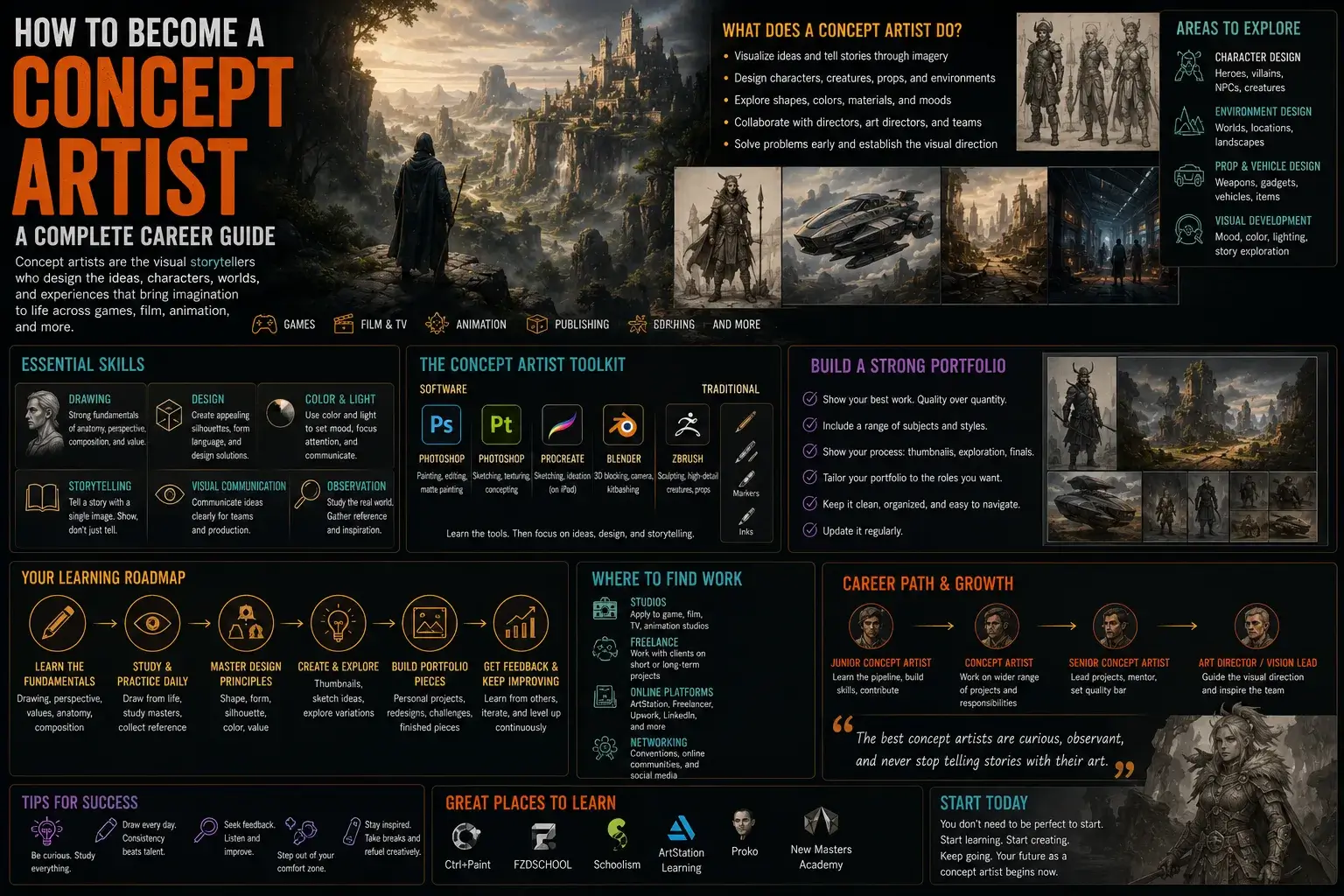
Concept art is one of the most creatively visible roles in the games and animation industries. Concept artists define the visual language of entire worlds — designing the characters, environments, vehicles, creatures, and props that everything else in a production is built from. It is also one of the most competitive disciplines to break into, with significantly more talented artists applying for roles than there are positions available at any given time. Understanding what the role actually involves, what skills are required, and how to build a career that stands out is essential if concept art is where you want to go.
This guide covers the concept artist career path — from the different types of concept art specialisation through to portfolio advice, career progression, and what studios are actually looking for when they hire. If you are ready to explore current opportunities, browse concept art and creative jobs on PixelCareer.
What Concept Artists Actually Do
Concept artists create the visual reference that guides the entire production of a game, film, or animation. Before a single 3D model is built, a single frame is animated, or a single environment is constructed, the look, feel, and design language of those elements is established through concept art.
The work falls into several broad categories:
Character design: Designing the visual appearance of characters — their silhouette, costume, colour palette, personality expression, and how they read at different scales and in different lighting conditions. Character concept artists create turnaround sheets, expression sheets, and detail studies that give the character art team everything they need to build and animate the character in 3D.
Environment design: Designing the spaces players inhabit or characters move through — the architectural language of a city, the atmosphere of a landscape, the visual logic of an alien world. Environment concept artists create both wide establishing shots that capture the mood and scale of a space, and detailed studies of specific architectural or natural elements that will be modelled.
Creature and vehicle design: Designing non-human characters, monsters, and mechanical assets — applying the same visual logic as character design to forms that may have no real-world reference. Creature concept artists need a deep understanding of anatomy, both real and invented, to create designs that feel believable even when they are entirely fantastical.
Props and assets: Designing the objects that populate the world — weapons, furniture, tools, containers, and the thousands of individual items that make an environment feel lived-in and real. Prop concept is often considered entry-level concept work, but strong prop design requires the same rigorous visual thinking as character or environment design.
Key art and visual development: At a more senior level, concept artists contribute to the overall visual direction of a production — establishing mood boards, colour scripts, and key illustrations that define the aesthetic and tonal direction of the entire project.
Essential Skills for Concept Artists
Drawing and painting fundamentals: More than any other role in the creative industry, concept art demands exceptional foundational art skills — perspective, anatomy, value, colour, and composition. These skills take years to develop and cannot be shortcut by software proficiency. Studios evaluate concept art portfolios primarily on the quality of the underlying drawings and paintings, not on the tools used to create them.
Design thinking: A concept artist is not just an illustrator — they are a designer. The ability to create designs that serve the narrative, that communicate character and story through visual choices, that read clearly at different scales and in different contexts, and that are buildable by the 3D artists who will model from them is what separates a concept artist from an illustrator.
Digital painting proficiency: Photoshop remains the primary digital painting tool for concept art. Procreate is widely used for sketching and early ideation, particularly on iPad. Clip Studio Paint has a strong following among character-focused concept artists. Developing speed and fluency in digital painting tools is essential — production environments require concept artists to produce high-quality work quickly.
3D software as a design tool: An increasing number of concept artists use 3D software — ZBrush, Blender, or Cinema 4D — to explore forms, establish perspective, and create base meshes that they paint over. This is not a replacement for traditional drawing skills but a supplement that allows faster exploration of complex designs. Concept artists who can work fluidly across 2D and 3D are increasingly valued in production environments.
Speed and ideation: Production concept art is fast. Concept artists are frequently required to produce multiple distinct design variations of a character, environment, or prop within a single day — giving the creative director options to evaluate and iterate from rather than laboured individual paintings. The ability to generate a high volume of viable ideas quickly, without sacrificing quality, is one of the core professional skills of the discipline.
The Concept Artist Career Path
Junior Concept Artist (0 to 3 years): Entry-level concept artists typically handle prop design, secondary character variations, and simpler environment studies under close direction from senior artists. At this stage, the priority is developing speed, consistency, and a thorough understanding of the studio’s production pipeline and visual language.
Mid-Level Concept Artist (3 to 6 years): At mid-level, you are expected to handle more complex design assignments with greater independence — primary character designs, hero environment paintings, and creature concepts that require significant creative decision-making. The ability to present and articulate design decisions to creative directors and leads is increasingly important at this stage.
Senior Concept Artist (6 to 10 years): Senior concept artists handle the most challenging and creatively significant assignments on a production. They contribute to visual direction decisions, mentor junior team members, and often work directly with art directors and creative directors on establishing the overall visual language of a project.
Art Director / Visual Development Lead: The career path beyond senior concept artist typically leads toward art direction — taking ownership of the visual direction of entire productions or specific areas within them. Art directors hire concept artists, brief them, review their work, and ensure the visual consistency of the project as a whole.
Building a Concept Art Portfolio
Your portfolio is the entirety of your application for any concept art role. It needs to demonstrate not just that you can produce beautiful images, but that you can design — that you understand how to create visuals that serve a production’s needs.
A strong concept art portfolio for games and animation typically includes:
- Character designs with full turnarounds, expression sheets, and detail studies — not just a single illustration
- Environment designs that show atmospheric mood alongside detailed architectural or natural elements
- Creature or vehicle designs if these are part of your target specialisation
- Evidence of design thinking — sketches, variations, and ideation sheets that show your process, not just your finished output
- Work that demonstrates your ability to design within a consistent visual language — either matching a specific studio’s aesthetic or establishing a coherent one of your own
Avoid portfolio padding. Studios reviewing concept art applications are experienced at identifying work that is technically accomplished but not genuinely original in design thinking. Every piece in your portfolio should demonstrate something that the other pieces do not already cover.
Concept Art Salaries in 2026
- Junior Concept Artist (US): $45,000 – $65,000 per year
- Mid-Level Concept Artist (US): $65,000 – $95,000 per year
- Senior Concept Artist (US): $95,000 – $130,000 per year
- Art Director (US): $120,000 – $170,000+ per year
Concept art roles at AAA games studios and major film studios typically sit at the higher end of these ranges. Freelance concept artists can earn day rates of £300 to £700 in the UK and $400 to $1,000 in the US, depending on experience and client type.
Frequently Asked Questions
Is concept art a stable career?
Concept art is a project-based discipline, and employment can be cyclical depending on the production pipeline at a given studio. Many concept artists work a combination of staff roles and freelance contracts throughout their careers. Building a strong reputation and professional network is the most reliable form of career stability in the discipline.
Do I need to be able to draw traditionally to be a concept artist?
Yes — traditional drawing skills, particularly perspective, anatomy, and composition, are fundamental to strong concept art. While most professional concept artists work digitally, the underlying skills are the same regardless of the tool. Studios evaluate the quality of the drawing and design thinking, not the medium it was created in.
How do I get my first concept art job with no professional experience?
Build a portfolio that demonstrates production-quality design work — even if it is from personal projects, fan art of existing franchises, or art school assignments. Apply for junior and entry-level roles specifically. Consider prop design or secondary character work as entry points, as these are more accessible to junior candidates than hero character or lead environment roles. Be persistent — breaking into concept art typically takes longer than breaking into some other creative disciplines because competition is intense.
Is concept art a good career path?
For people with genuine passion for visual design and drawing, concept art is an extremely rewarding career. The work is creatively meaningful, the community is strong, and the demand for skilled concept artists across games, film, and animation remains consistent. The path to a sustainable career is longer and more competitive than in some other creative disciplines, but the payoff for those who get there is significant.
Can concept artists work remotely?
Yes — concept art is one of the more remote-friendly disciplines in the creative industry, since deliverables are image files that can be shared and reviewed digitally. Many concept artists work as remote freelancers or in hybrid staff roles. The growth of cloud-based review tools and collaborative design platforms has made remote concept art work increasingly practical for studios of all sizes.
Final Thoughts
Concept art is one of the most creatively rewarding disciplines in the games and animation industries — and one of the most demanding to build a career in. The combination of exceptional drawing fundamentals, strong design thinking, digital painting proficiency, and the speed to produce quality work under production pressure takes years of deliberate practice to develop.
For those who put in that work, the career is genuinely exceptional — the opportunity to define the visual identity of entire worlds, to see your designs realised in shipped products that millions of people experience, and to work alongside some of the most talented visual artists in the world makes it worth every difficult year of the journey.
Explore current opportunities — browse concept art and creative industry jobs on PixelCareer.