
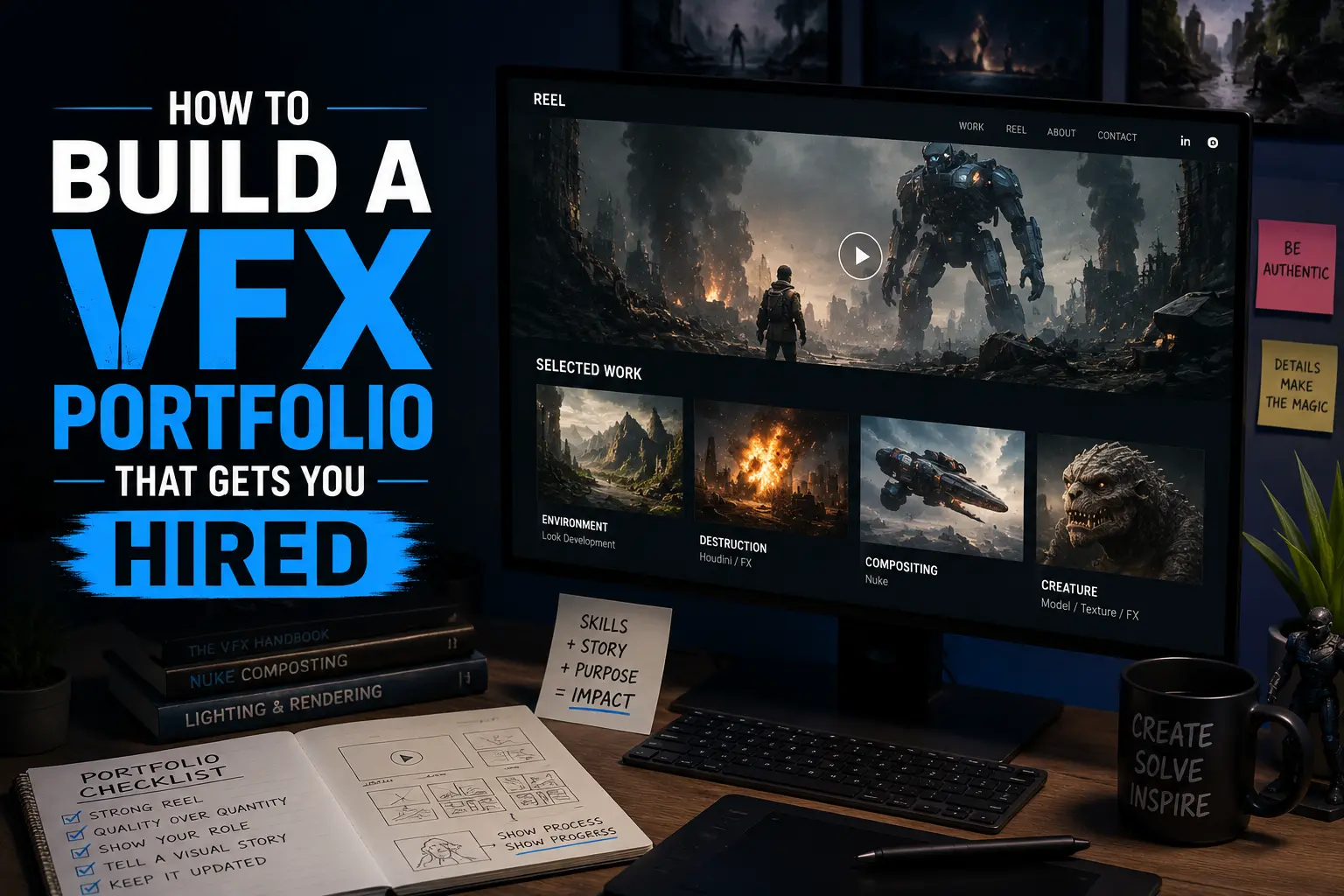
Building a strong VFX portfolio is the single most important step you can take to launch or advance your career in visual effects. Whether you are a recent graduate applying for your first junior role or an experienced artist targeting a position at a top-tier studio, your portfolio reel is what opens doors — more than your degree, more than your CV, and more than your cover letter. Studios receive hundreds of applications for every open position. The ones that move forward are the ones with work that immediately communicates skill, range, and professional quality.
This guide covers everything you need to know to build a VFX portfolio that gets you hired in 2026 — from selecting the right shots and structuring your reel, to hosting your work professionally and avoiding the mistakes that get reels rejected before anyone reads your application. If you are actively looking for VFX roles, you can also browse current VFX and post-production job openings on PixelCareer.
What Studios Are Actually Looking For
Before you build anything, it helps to understand how your portfolio gets reviewed. At most mid-to-large studios, your reel is watched by a lead artist or department supervisor — often while they are also reviewing ten other reels the same afternoon. You have roughly 30 to 60 seconds to make an impression before they move on.
What they are evaluating in that window:
- Technical competence — Can this person actually do the work at a professional level?
- Eye for quality — Do they know what good looks like?
- Relevance — Does their work match what we actually need?
- Efficiency — Can they communicate their skills without wasting time?
Studios are not looking for quantity. They are looking for evidence that you can do the job they are hiring for.
Choosing What to Include
The most common VFX portfolio mistake is including too much. Artists feel that more work demonstrates more capability — but in practice, a reel padded with mediocre shots undermines the strong ones.
A focused reel of four to six exceptional shots will outperform a bloated reel of fifteen average ones every time. When selecting work, ask yourself these questions about each piece:
- Is this the best example of this skill I have?
- Would I be proud to show this to the lead artist I want to work for?
- Does this piece add something different to what is already in my reel?
If the answer to any of these is no, cut it.
What to Include Based on Your Specialisation
Your reel should reflect the role you are applying for. A compositor’s reel looks different from an FX artist’s reel — and hiring teams notice immediately when someone sends a generic reel for a specific role.
Compositing: Show clean green screen work, colour integration, light matching, and ideally one complex multi-layer composite that demonstrates your understanding of the full pipeline.
FX/Simulation: Prioritise destruction, fluid, fire, smoke, and cloth simulations. Show your Houdini or equivalent tool proficiency clearly. Breakdowns are essential here — studios want to see your node graphs and process, not just the final render.
Motion Graphics: Lead with variety — show type animation, brand work, UI animation, and at least one piece that demonstrates 3D integration. Pace matters enormously in motion graphics reels.
Environment/Lighting: Show your understanding of light, atmosphere, and photorealism. Include at least one shot that demonstrates your ability to match real-world reference.
Reel Structure and Pacing
The structure of your VFX demo reel matters as much as the content. A poorly edited reel with great work will underperform a well-edited reel with good work.
Open strong. Your best shot goes first. Not second, not third — first. You have seconds to convince someone to keep watching.
Close strong. Your second-best shot goes last. The beginning and end are what people remember.
Keep it short. Aim for 60 to 90 seconds for a specialist reel. Motion graphics reels can stretch to two minutes if the pacing is tight. Anything over two and a half minutes is too long unless you are applying for a senior role with genuinely exceptional work to show.
Use music carefully. Choose something neutral and non-distracting. Avoid anything with lyrics. The music should support the pacing of your cuts, not compete with your work for attention.
Include text overlays sparingly. Labelling shots with the software used and your contribution is useful — but keep it clean and readable. Do not cover the actual work.
Breakdowns Are Non-Negotiable
For technical VFX roles — FX, compositing, rigging, lighting — a breakdown video is as important as the reel itself. A breakdown shows your process: the raw plate, the individual passes, the node graph or simulation setup, and the final result.
Studios want to know not just that you can produce a good result, but that you understand why it looks the way it does. Structure your breakdown clearly:
- Final shot
- Raw plate or reference
- Individual elements — mattes, passes, simulations
- Your actual tool setup — nodes, graphs, layers
- Final composite again
Keep breakdowns concise. Two to three minutes maximum, focusing on your most complex or impressive work.
Software and Technical Requirements
The tools you know matter — but less than many junior artists think. Studios teach their pipeline. What they cannot teach is artistic judgment and a strong eye for quality. That said, industry-standard tools are worth knowing:
- Compositing: Nuke is the industry standard for film and high-end TV. After Effects is widely used in motion graphics, broadcast, and games.
- FX/Simulation: Houdini dominates film and AAA games VFX. You can find comprehensive learning resources at SideFX’s official learning hub.
- 3D: Maya and Blender are the most common. Cinema 4D is popular in motion graphics.
Your reel should clearly demonstrate proficiency in whichever tools you use. If you work in Houdini, make your Houdini knowledge visible in your breakdowns.
Where to Host Your VFX Portfolio
Your portfolio needs to be accessible, fast, and professional. A recruiter who cannot easily find or play your reel will not chase it down.
Vimeo is the preferred platform for VFX reels. The playback quality is higher than YouTube and it carries a more professional association in the industry. Set your reel to public and make sure it plays without requiring a login.
A personal website is worth building even if it is simple. Keep the design minimal — the work should be the focus. Your name, your reel, your contact details, and a few selected stills is all you need.
ArtStation is widely used in the games and VFX industries. Maintain an active profile with your best individual pieces alongside your reel. Many studios actively recruit directly from ArtStation.
Avoid hosting your primary reel on Google Drive, Dropbox, or any platform that requires the reviewer to download a file. Friction kills applications.
Common Mistakes That Get Reels Rejected
Including tutorial work without flagging it. If work is from a tutorial or class project, label it clearly. Passing off tutorial results as original work is immediately obvious to experienced artists.
Poor presentation. A reel with inconsistent resolution, audio sync issues, or sloppy text overlays signals a lack of attention to detail — one of the core qualities studios look for.
No context for collaborative work. If a shot was done as part of a team, clearly state your specific contribution. Claiming sole credit for work you did not do alone will come out in an interview.
Sending a generic reel to every studio. Tailor your reel to the job. If you are applying for a compositing role, lead with compositing. If you are applying to a games studio, include real-time or engine work where possible.
Outdated work. A reel dominated by work that is three or four years old suggests you have not been developing your skills. Keep your portfolio current.
Practical Steps to Build Your Reel Right Now
- Audit your existing work. List everything you have made. Flag the top three to five pieces objectively.
- Identify the gaps. If you are targeting compositing roles but have no green screen work, create a personal project to fill that gap.
- Record a breakdown. Take your strongest shot and create a thorough breakdown video this week.
- Set up a Vimeo account and upload your reel at the highest quality setting.
- Create or update your ArtStation profile with individual stills and process images from your best work.
- Get feedback. Share your reel in professional communities — Reddit’s r/vfx, Discord servers for Houdini or Nuke users, or with peers who already work in the industry.
Frequently Asked Questions
How long should a VFX portfolio reel be?
For most specialist roles, aim for 60 to 90 seconds. Motion graphics reels can run up to two minutes if the pacing is strong. Anything over two and a half minutes should only be considered if you are applying for a senior position and every shot is genuinely exceptional.
Should I include personal projects in my VFX reel?
Absolutely. Personal projects demonstrate initiative, passion, and the ability to self-direct — all qualities studios value highly. Just make sure personal work is at the same quality level as any professional work you include. Label it clearly as a personal project.
What software should I learn for a VFX career?
It depends on your specialisation. For compositing, Nuke is the industry standard for film. For FX and simulation, Houdini is dominant. For 3D, Maya is most common in film and TV, while Blender is increasingly accepted. Focus on one tool deeply rather than spreading yourself too thin across many.
Do I need a website as well as a Vimeo reel?
A personal website is not strictly required, but it is worth having. It gives you a professional home base, makes you easy to find, and lets you present your work on your own terms. Keep it simple — your reel, a selection of stills, and your contact details is enough.
How often should I update my VFX portfolio?
Treat your portfolio as a living document. Replace weaker shots as your skills improve, add recent work from new productions, and always lead with your current best. A good rule is to review and update your reel at least every six months.
Final Thoughts
A strong VFX portfolio is built through consistent effort, honest self-assessment, and a genuine passion for the craft. Start with your best work, be selective, show your process through breakdowns, and keep updating your reel as you grow.
If you are ready to put your portfolio to work, browse VFX and post-production jobs on PixelCareer and find your next opportunity at a leading studio or production company.