
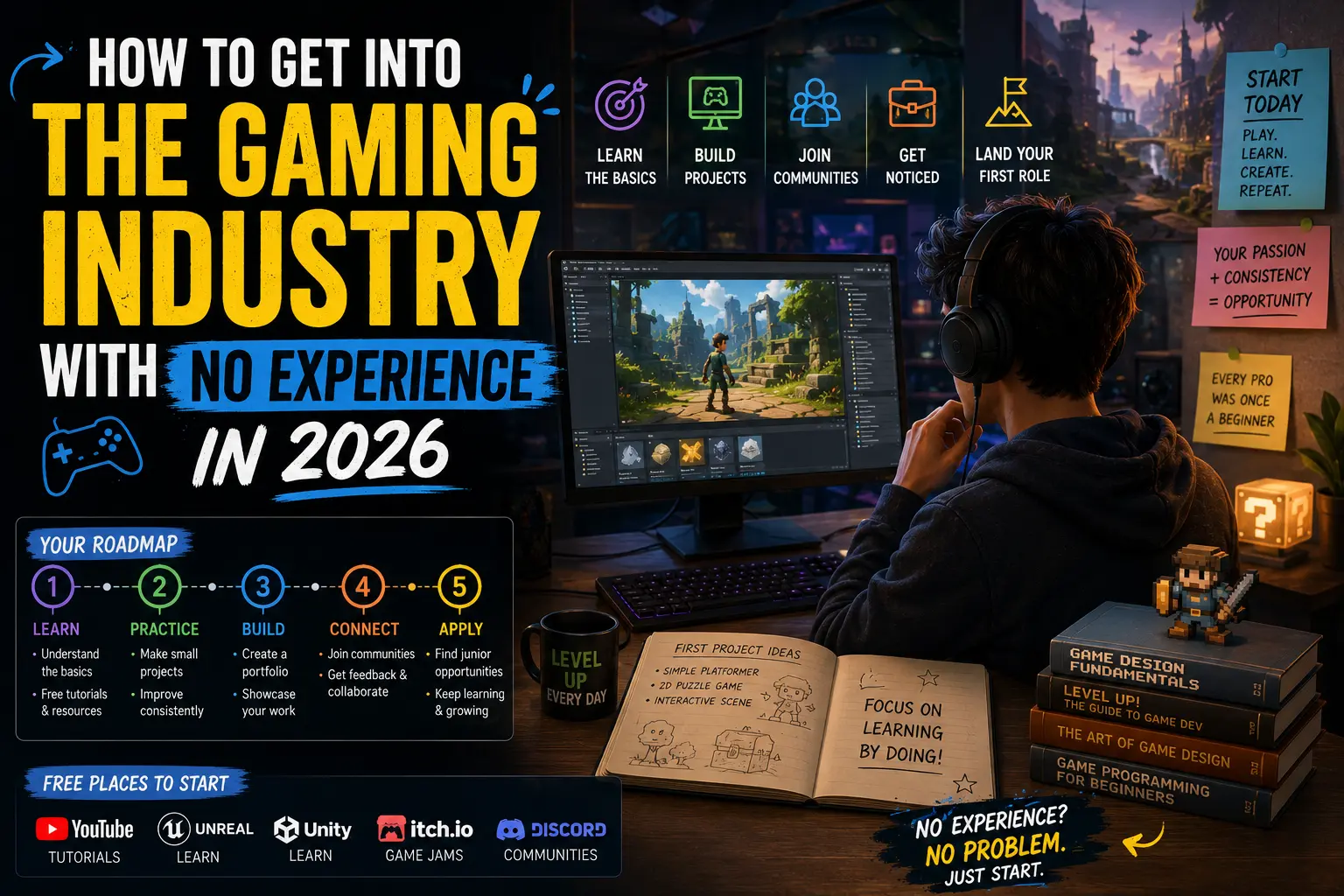
Breaking into the gaming industry without professional experience is one of the most common challenges facing aspiring game developers, designers, and artists. The good news is that the games industry is one of the few creative sectors where demonstrated skill consistently outweighs formal credentials. Studios hire people who can do the work — and if you can prove that through your portfolio, your projects, and your knowledge of the craft, professional experience becomes far less of a barrier than it might seem.
This guide covers the exact steps to take to get into the gaming industry in 2026, whether your goal is game design, art, programming, production, or QA. If you are already building toward your first role, you can browse entry-level gaming jobs on PixelCareer and start identifying the types of roles you are targeting.
Understand What the Gaming Industry Actually Looks Like
Before you can break into the gaming industry, it helps to understand how it is structured. The games industry is not a single monolithic sector — it is a collection of very different types of companies, each with different hiring needs, cultures, and career paths.
AAA Studios: Large studios producing high-budget titles for console and PC. Examples include studios owned by EA, Activision Blizzard, Ubisoft, and Sony. These studios hire specialists with strong portfolios and relevant experience. Breaking in at entry level is competitive but possible, particularly in QA, art, and junior programming roles.
Mid-Sized Studios: Studios with 50 to 500 employees, often producing titles for console, PC, or mobile. These studios frequently offer the best entry-level opportunities — large enough to have structured roles, small enough to value versatility and potential over pedigree.
Indie Studios: Small teams, often two to twenty people, producing independent games. Indie studios rarely have the budget for dedicated entry-level roles, but they are an excellent environment if you can contribute meaningfully from day one. Many successful games industry professionals started at indie studios or on indie projects.
Mobile and Social Games: Companies producing games for iOS, Android, and social platforms. The mobile sector is the largest segment of the global games market and hires across design, art, production, and data roles. Mobile studios are often more open to candidates from adjacent industries than traditional console studios.
Games-Adjacent Companies: Tech companies, agencies, and platforms that work with games but are not studios themselves — including middleware providers, tools developers, esports organisations, and gaming media companies. These organisations are worth targeting if you are struggling to break into studios directly.
Choose Your Discipline and Focus There First
The gaming industry is broad, and the mistake many aspiring professionals make is trying to demonstrate competence across too many disciplines at once. Studios hire specialists. A generalist portfolio with mediocre work in five areas will underperform a focused portfolio with exceptional work in one.
The main entry points into the gaming industry are:
- Game Design — systems, level, narrative, and UX design
- Art — 2D art, 3D art, animation, VFX, concept art, and UI art
- Programming — gameplay, engine, tools, and technical art
- Production — project management, producer, and coordination roles
- QA and Testing — quality assurance and game testing
- Audio — sound design and music composition
- Marketing and Community — social media, community management, and PR
Choose the discipline that aligns with both your existing skills and your genuine interests. The gaming industry is full of people who are passionate about what they do — that enthusiasm is immediately visible in interviews and portfolios, and it matters.
Build a Portfolio That Opens Doors
Your portfolio is your most important asset when breaking into the gaming industry without professional experience. It is the primary way studios evaluate candidates who do not yet have a track record of shipped titles.
A strong entry-level portfolio does not need to be extensive. It needs to demonstrate that you can produce work at a professional standard and that you understand the fundamentals of your discipline.
For Game Designers
Create a design portfolio that includes at least one fully documented game design project — a game design document, a level design walkthrough, or a systems design breakdown. Show your thinking process, not just the output. Studios want to understand how you approach design problems, not just what the end result looks like.
Prototype simple games using accessible tools like Unity, Unreal Engine, or GameMaker. A playable prototype that demonstrates a core mechanic you designed is worth more than a lengthy written document about a game you have not built.
For Artists
Build an ArtStation portfolio with four to eight polished pieces that demonstrate your core discipline. Focus on quality over quantity. Each piece should reflect professional standards — clean topology if you are a 3D artist, strong fundamentals if you are a concept artist, smooth and believable movement if you are an animator.
Study the art style of the studios you want to work for and create at least one piece that demonstrates you can work within that aesthetic. This shows studios you understand their product and can hit the ground running.
For Programmers
Build and release small games or tools, and host the source code on GitHub. A playable game — even a simple one — that you built from scratch demonstrates far more than a list of languages on a CV. Document your code well and include a README that explains what the project is and the technical decisions you made.
For QA and Production
These disciplines are harder to demonstrate through a traditional portfolio. Focus instead on transferable skills — project management experience, bug reporting documentation, organised communication, and any experience coordinating teams or managing timelines. Certifications in project management tools like Jira or Confluence are worth obtaining.
Make Your Own Games and Projects
One of the most effective ways to break into the gaming industry without professional experience is to make games independently. Game jams are structured events where participants create a complete game within a short time limit — typically 48 to 72 hours. They are free to enter, widely participated in by industry professionals, and an excellent way to build your portfolio, develop collaboration skills, and make connections.
The most accessible game jams for beginners include:
- Global Game Jam — the world’s largest game jam, held annually in January
- Ludum Dare — one of the oldest and most respected game jams, held three times per year
- itch.io game jams — hundreds of themed jams running year-round on the itch.io platform
Completing and publishing a game — even a small one — demonstrates that you can finish a project, which is one of the most valued qualities in the games industry. Many aspiring developers spend years planning games they never complete. Finishing something, however simple, immediately sets you apart.
Use QA as Your Entry Point
Quality assurance — game testing — is the most accessible entry point into the games industry for candidates without specific technical or artistic skills. QA roles are available at studios of all sizes, are frequently hired without strict experience requirements, and give you direct exposure to the game development pipeline from inside a professional studio.
A QA position is not a permanent role for most people — it is a stepping stone. Many successful game designers, producers, and project managers began their careers in QA, using the access it provided to learn the pipeline, build internal relationships, and demonstrate their capabilities to the teams they wanted to join.
If you are struggling to get traction with applications for design or art roles, actively targeting QA positions at studios you admire is a highly effective strategy for getting your foot in the door.
Develop Industry Knowledge Actively
Studios want to hire people who are genuinely passionate about games. Demonstrating that passion through active, visible engagement with the industry — beyond just playing games — makes a significant difference in how your application is received.
Practical ways to develop and demonstrate industry knowledge:
- Play games critically. Analyse the games you play — what design decisions were made, why they work or do not work, how the UI guides player behaviour. Bring this analytical perspective into your interviews and written applications.
- Read industry publications. Gamasutra, Game Developer Magazine, and the Game Developers Conference session vault are all valuable resources for understanding how games are made professionally.
- Watch postmortems and GDC talks. The GDC Vault contains hundreds of free talks from industry professionals covering every aspect of game development. These are an invaluable resource for understanding how real productions work.
- Follow studios on social media. Understanding a studio’s culture, current projects, and values before you apply makes your application significantly more targeted and credible.
Build Your Network in the Gaming Industry
The gaming industry is smaller than it appears from the outside. Most hiring happens through networks — a recommendation from a trusted colleague carries far more weight than a cold application in most studios.
Building a professional network in the games industry does not require knowing people already. It requires being present in the places where the industry gathers:
- Game jams — as covered above, these are excellent networking environments because everyone is there to collaborate and learn
- Industry events and conferences — GDC, EGX, PAX, and local developer meetups are all opportunities to meet people working in the industry
- Online communities — Discord servers for specific game engines, subreddits like r/gamedev, and LinkedIn groups connect you with working professionals who are often willing to share advice and occasionally aware of openings
- Twitter/X and LinkedIn — following and engaging thoughtfully with developers who share their work publicly builds visibility over time
Networking is not about asking people for jobs. It is about building genuine relationships with people who share your interests. The job opportunities follow naturally from those relationships over time.
Tailor Every Application You Send
Generic applications are the most common reason candidates with strong portfolios do not get interviews. Studios receive hundreds of applications for every open role — the ones that get read are the ones that feel like they were written specifically for that studio and that position.
For every application you send:
- Research the studio — know their titles, their culture, and why you want to work there specifically
- Tailor your cover letter to that studio — reference their games, their values, and how your skills are relevant to what they are building
- Adjust your portfolio to front-load work most relevant to the role
- Address the specific requirements listed in the job description, not just your general capabilities
Sending twenty tailored applications will produce significantly better results than sending two hundred generic ones.
Consider Education — But Choose Carefully
Formal education in game development — degrees, diplomas, and specialist courses — can accelerate your entry into the industry, but it is not a requirement and the quality varies enormously between programmes.
If you are considering education, evaluate it against one primary criterion: does this programme produce graduates who get hired at studios I want to work for? If the answer is not clearly yes, the cost and time investment may not be justified. Many successful games industry professionals are self-taught or attended short specialist bootcamps rather than multi-year degree programmes.
Short, focused courses on specific tools — Houdini, Unreal Engine, Unity, Substance Painter — are often a better investment of time and money than broad degree programmes, particularly if you already have a clear sense of your target discipline and role.
Frequently Asked Questions
Is it hard to get into the gaming industry with no experience?
It is competitive but achievable. The gaming industry values demonstrated skill over credentials. A strong portfolio, personal projects, and visible passion for the craft can open doors even without professional experience. QA roles are the most accessible entry point if you are struggling to get traction with specialist applications.
What qualifications do you need to work in the gaming industry?
Most gaming industry roles do not have strict qualification requirements. What studios care about is whether you can do the work. A portfolio that demonstrates professional-quality skills is more important than a specific degree. That said, some technical roles — particularly in engineering — may favour candidates with computer science backgrounds.
What is the easiest gaming industry job to get with no experience?
QA testing is widely considered the most accessible entry-level role in the games industry. Studios hire QA testers at all levels and do not typically require specific technical or artistic skills. Other accessible entry points include community management, social media coordination, and production assistant roles at smaller studios.
How long does it take to break into the gaming industry?
There is no fixed timeline. Some people land their first industry role within months of actively building their portfolio and applying. Others spend a year or more developing their skills before getting their first offer. The most important factor is the quality of the work you are producing — focused, consistent development of your portfolio will produce results faster than a high volume of unfocused applications.
Do game studios hire self-taught developers and artists?
Yes — many successful games industry professionals are entirely self-taught. Studios care about the quality of your work and your ability to contribute to their production, not how you acquired your skills. Self-taught candidates who can demonstrate professional-level output through their portfolio are hired regularly across art, design, and programming disciplines.
Final Thoughts
Breaking into the gaming industry without professional experience requires patience, focused skill development, and consistent effort over time. The candidates who succeed are the ones who build strong, targeted portfolios, make games independently, engage with the industry community, and apply strategically rather than broadly.
The gaming industry is growing and studios are always looking for talented people who can genuinely contribute. If you are willing to put in the work to develop your skills and demonstrate them effectively, the door is more open than it might currently appear.
Start exploring available opportunities now — browse gaming industry jobs on PixelCareer and find entry-level roles at studios worldwide that match your skills and ambitions.