
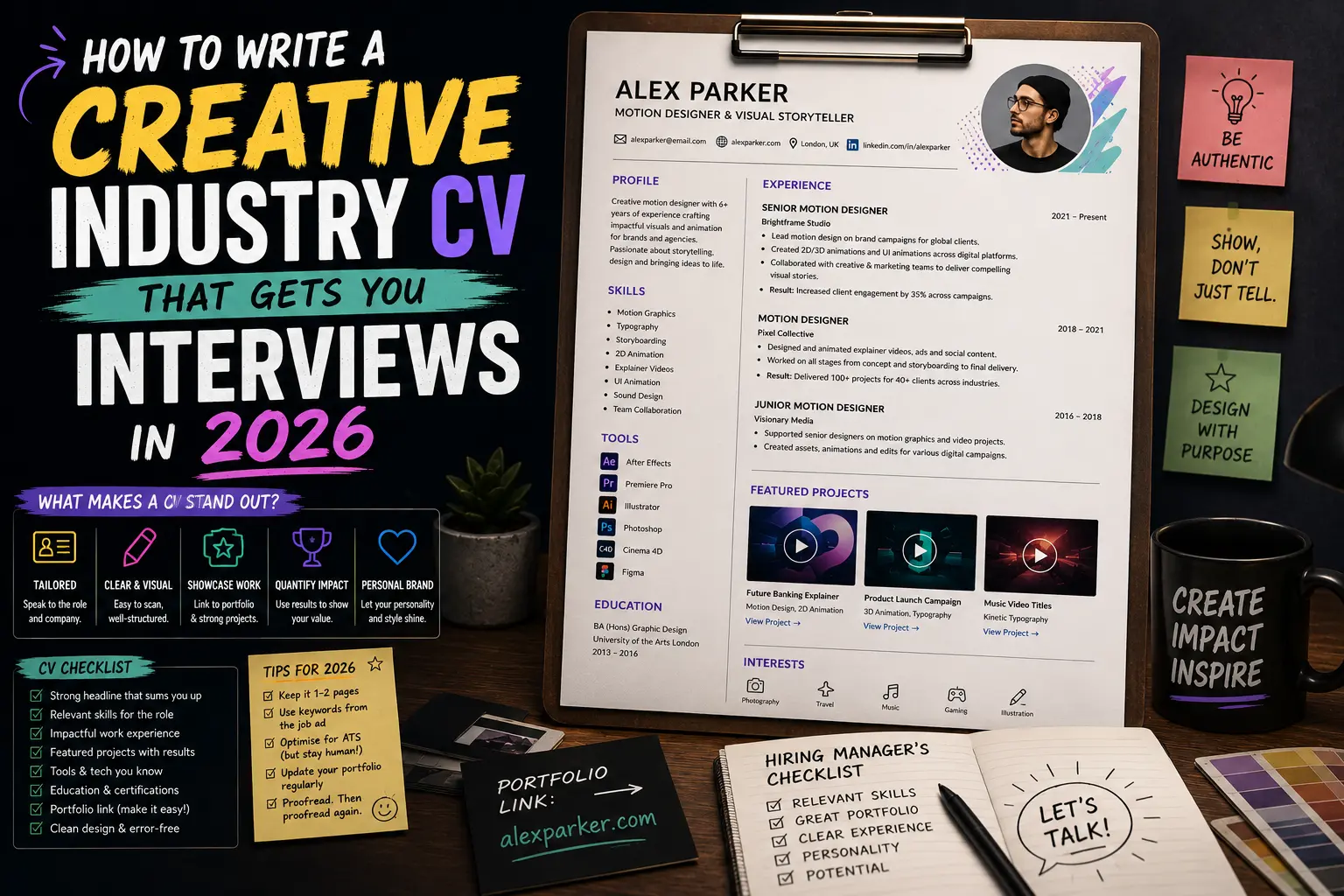
A well-written CV will not get you a job in the creative industry on its own — your portfolio will always carry more weight. But a poorly written CV can absolutely cost you an interview, even if your work is exceptional. Hiring managers at studios and agencies review dozens of applications for every open role. A CV that is hard to read, poorly structured, or full of irrelevant information creates friction at exactly the moment you need to make a strong impression. Getting your CV right removes that friction and lets your portfolio do the talking.
This guide covers how to write a CV for animation, VFX, gaming, UI/UX, and motion design roles — including what to include, what to cut, how to structure it for maximum clarity, and the mistakes that consistently hold creative professionals back from getting interviews. If you are ready to start applying, browse current creative industry jobs on PixelCareer and find roles that match your skills and experience level.
How a Creative Industry CV Is Different
A CV for a creative industry role is not the same as a CV for a corporate or general professional role. The context is different, the priorities are different, and the conventions that apply in other sectors often do not apply here.
The most important difference is this: in the creative industry, your CV is a supporting document, not the primary one. Your portfolio, reel, or work samples are what studios evaluate first. Your CV provides context — it tells the reviewer who you are, where you have worked, what you have shipped, and what tools you use. It is read after your work has already made an impression, not before.
This changes how you should write it. A creative industry CV does not need to be exhaustive. It needs to be clear, specific, and easy to scan in 60 seconds. Brevity and precision are more valued than comprehensiveness.
CV Structure for Creative Industry Roles
A clear, consistent structure makes your CV easy to read and ensures the most important information is visible immediately. The recommended structure for creative industry CVs is:
- Header — your name, job title, location, email, portfolio URL, and LinkedIn
- Professional Summary — two to four sentences summarising who you are and what you bring
- Skills — a concise list of your core technical skills and software proficiencies
- Experience — your work history in reverse chronological order
- Education — your academic background, briefly stated
- Additional — awards, publications, conference talks, or notable personal projects if relevant
Keep your CV to one page if you have fewer than five years of experience. Two pages is acceptable for senior professionals with extensive credits. Three or more pages is almost always too long.
The Header — Make It Instantly Useful
Your header should contain everything a studio needs to contact you and evaluate your work at a glance. Include:
- Your full name — in a larger font size than the rest of the document
- Your job title — what you are, not what you want to be. “Senior VFX Artist” or “Motion Designer” — not “Aspiring Game Designer”
- Your location — city and country is sufficient. You do not need a full address.
- Your email address
- A direct link to your portfolio, reel, or ArtStation profile — this is the most important link you will include
- LinkedIn profile URL if it is up to date and adds value
Do not include a photograph, date of birth, nationality, or marital status. These are not relevant to hiring decisions in the creative industry and add unnecessary personal information to your document.
Professional Summary — Two to Four Sentences That Frame Everything
A professional summary at the top of your CV gives the reviewer immediate context before they read anything else. It should answer three questions in two to four sentences: who are you, what do you do, and what makes you worth reading further?
A strong professional summary for a creative industry CV is specific, not generic. Compare these two examples:
Weak: “A passionate and creative professional with experience in animation and design, looking for an exciting new opportunity to grow and develop my skills in a dynamic team environment.”
Strong: “Character animator with six years of experience across feature film and AAA games, specialising in performance animation and creature work. Credits include two shipped console titles and one streaming series. Proficient in Maya with strong knowledge of motion capture cleanup and Unreal Engine integration.”
The second example is specific, credible, and immediately useful. The first could have been written by anyone and tells the reader nothing they could not infer from the rest of the document.
Skills Section — Be Specific and Honest
The skills section of a creative industry CV should be a concise, scannable list of your actual technical proficiencies. It is one of the first things a hiring manager looks at when reviewing applications — studios are often hiring for specific tool requirements, and a clearly presented skills section makes it easy to confirm you meet them.
Structure your skills section clearly:
- Primary software: List the tools you use daily and know deeply — Maya, After Effects, Houdini, Nuke, Blender, Unreal Engine, Unity, Figma, etc.
- Secondary software: Tools you use regularly but are not your primary specialism
- Techniques and disciplines: Character animation, compositing, rigging, motion capture, UI design, systems design — whatever is relevant to your role
- Pipeline and collaboration tools: Shotgun/ShotGrid, Jira, Perforce, Git — these demonstrate professional pipeline experience
Do not list skills you do not genuinely have. Studios test for tool proficiency in technical interviews and art tests — overstating your capabilities will be apparent quickly and damages your credibility.
Avoid vague skill descriptors like “excellent communicator” or “strong team player” in your skills section. These belong in your professional summary at most — in the skills section, stick to specific, verifiable technical capabilities.
Experience Section — Credits and Contributions, Not Job Descriptions
The experience section is where most creative industry CVs go wrong. The temptation is to write detailed job descriptions for each role — bullet points that describe the general responsibilities of the position. This is almost always the wrong approach.
What studios want to know from your experience section is:
- Where you have worked and for how long
- What titles or projects you contributed to
- What your specific contribution was
- What you produced or achieved that was notable
For each role, include:
- Studio or company name
- Your job title
- Dates of employment — month and year is sufficient
- Two to four bullet points covering your key contributions and credits
Strong experience bullet points are specific and achievement-oriented. Instead of “Responsible for animating characters in the game,” write “Animated principal character performances for six hours of in-game cutscenes across a shipped AAA title.” Instead of “Worked on compositing tasks,” write “Delivered 47 VFX shots across a Netflix original series, specialising in digital environment extensions and crowd replication.”
If you have shipped titles — games, films, series, or commercial projects — list them. Credits are the currency of the creative industry. A CV that shows a clear track record of shipped work is immediately more credible than one that describes responsibilities without specifying outcomes.
Handling a Lack of Professional Experience
If you are early in your career and have limited professional experience, your experience section should still demonstrate that you have been productive and developing your skills. Include:
- Freelance projects — even small ones, if the output is professional quality
- Game jam entries — list the jam, your role, and link to the game if it is playable
- Personal projects of significant scope — particularly if they have been publicly released or received attention
- Internships, student productions, or collaborative projects
- Volunteer work on creative projects
Be honest about the context — label personal projects as such. But do not leave the experience section empty or sparse. If you have been making things, show that you have been making things.
Education — Keep It Brief
For most creative industry roles, education is the least important section of your CV. Include your highest relevant qualification, the institution, and the years attended. If you graduated with distinction or honours, include that. If you completed a specialist short course or bootcamp that is directly relevant to the role — a Houdini certification, a Nuke compositing course, a game design programme — include that too.
Do not list every course you have ever taken or pad this section with irrelevant qualifications. A senior animator does not need to list their secondary school results.
Common CV Mistakes That Cost Interviews
No portfolio link. Submitting a creative industry CV without a link to your work is the single most common and most costly mistake. Your portfolio link should be in your header, clearly labelled, and pointing directly to your reel or best work — not to a homepage that requires the reviewer to navigate further.
Generic objective statements. “Looking for an exciting opportunity to contribute my skills in a dynamic team” tells a studio nothing useful. Replace generic objective statements with a specific professional summary that communicates who you are and what you have shipped.
Poor formatting. A CV that is difficult to read — inconsistent fonts, cluttered layout, poor use of white space — reflects badly on a candidate who is applying for a visual role. Your CV does not need to be beautifully designed, but it should be clean, consistent, and easy to scan. Simple, well-structured documents in PDF format are more reliable than complex designed layouts that may not render correctly on all systems.
Irrelevant work history. If you worked in retail before transitioning to animation, that work history does not belong on your CV unless it is directly relevant to the role. Studio reviewers do not need to know about every job you have ever held — only the ones that demonstrate relevant skills or experience.
Spelling and grammar errors. The creative industry values attention to detail. A CV with typos or grammatical errors signals carelessness. Proofread your CV carefully, use a spell checker, and ask someone else to read it before you start sending it out.
Sending the same CV to every studio. Tailor your CV to each application. This does not mean rewriting it from scratch — it means adjusting your professional summary and the order of your skills to emphasise what is most relevant to the specific role and studio you are targeting.
Formatting and Design — Function Over Flair
There is a common misconception that creative professionals need highly designed, visually elaborate CVs. In practice, the opposite is often true. Hiring managers read large volumes of CVs and value clarity and speed of comprehension above visual creativity. A clean, well-structured document that communicates your information clearly will typically outperform a heavily designed layout that makes the content harder to scan.
Practical formatting guidelines:
- Use a clean, readable font — Inter, Helvetica, or Georgia are all appropriate choices
- Keep font sizes consistent — name larger, section headings slightly larger than body text, body text at 10 to 11 points
- Use clear section dividers — a simple horizontal line or generous spacing between sections improves scannability
- Export as PDF — this ensures your formatting renders consistently regardless of the system it is opened on
- Name your file clearly — “FirstName-LastName-CV.pdf” is professional and easy to find in a folder of applications
Frequently Asked Questions
Should a creative CV include a photo?
No — in the UK, US, Canada, and Australia, including a photo on your CV is not standard practice and is generally unnecessary. In some European markets it is more common but still not required. For creative industry roles specifically, your portfolio is far more important than your appearance. Leave the photo out.
How long should a creative industry CV be?
One page is ideal for candidates with fewer than five years of experience. Two pages is acceptable for senior professionals with extensive credits and production history. Anything longer than two pages is almost always too long and should be edited down. Hiring managers in the creative industry typically spend 30 to 60 seconds on an initial CV review — brevity is an asset.
Should I list software I am only a beginner in?
Only list software you can use at a professional standard. Listing tools you barely know wastes valuable space and can backfire if you are asked to demonstrate proficiency in an interview or art test. If there is a tool you are actively learning, you can mention it briefly in your professional summary — but do not list it alongside tools you know deeply.
Do I need a different CV for different types of creative roles?
Yes — at minimum, you should tailor your professional summary and skills section to each type of role you are applying for. A CV targeting a VFX compositing role should lead with compositing experience and relevant software. The same CV targeting a motion graphics role should emphasise After Effects proficiency and brand work. The core document can remain consistent, but the framing should change.
Is a cover letter necessary for creative industry jobs?
Not always — many studios focus primarily on the portfolio and CV. But when a cover letter is requested, or when you are applying to a studio you particularly want to work for, a well-written cover letter that demonstrates genuine knowledge of the studio and explains specifically why you want to work there can meaningfully strengthen your application. Keep it concise — three short paragraphs is enough.
Final Thoughts
A strong creative industry CV is not about impressing people with design or volume — it is about making it as easy as possible for a studio to understand who you are, what you have shipped, and why they should look at your portfolio. Clear structure, specific credits, honest skills, and a direct link to your best work are the foundations of a CV that gets interviews.
Invest the time to get it right, keep it updated as you ship new work, and tailor it thoughtfully for every application. A well-crafted CV removes barriers between your work and the people who need to see it.
Ready to put your CV to work? Browse creative industry jobs on PixelCareer — animation, VFX, gaming, UI/UX, motion design, and more — and find your next opportunity.