
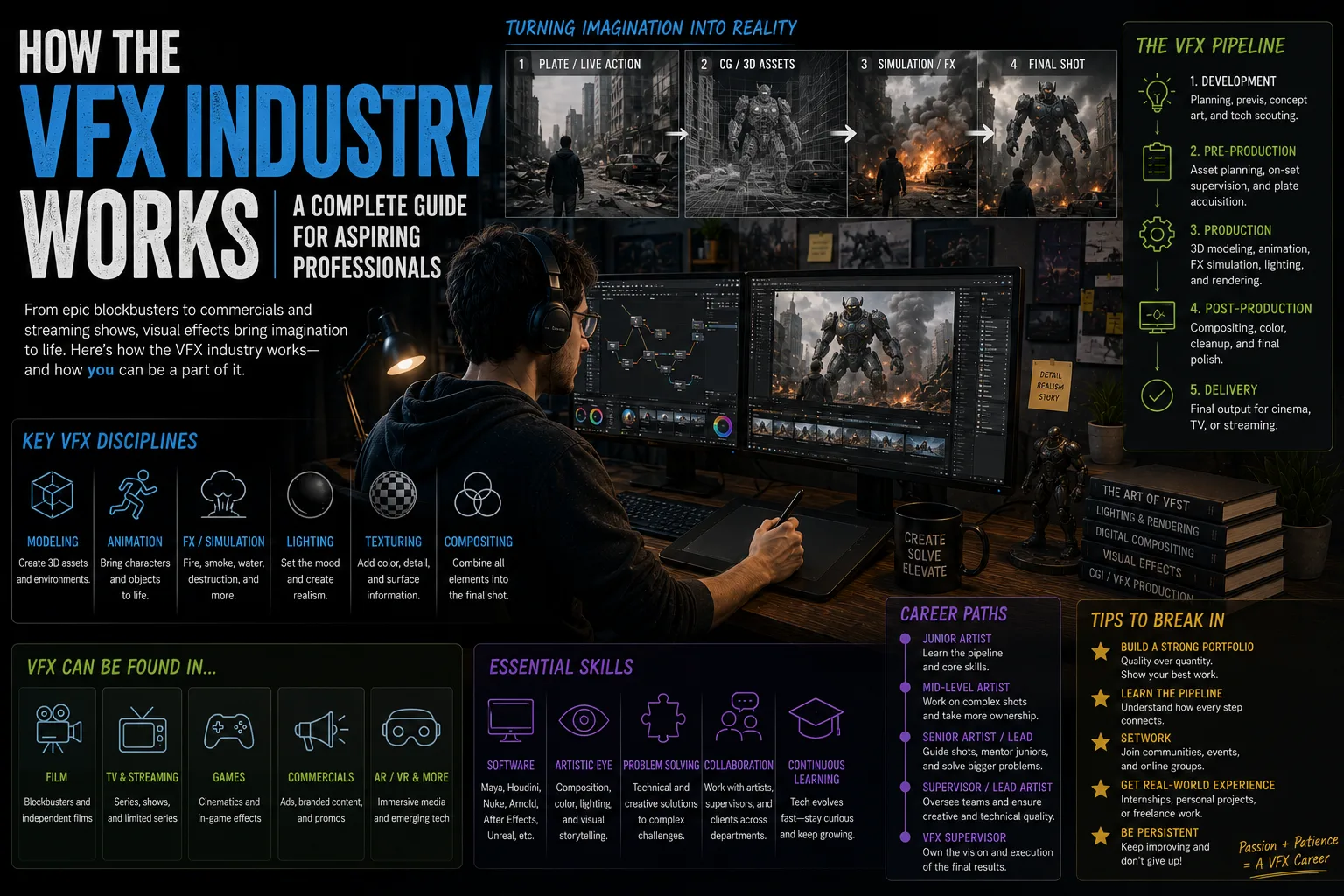
The visual effects industry is one of the most technically complex and creatively demanding sectors in the entertainment world. In 2026, VFX is present in virtually every major film and television production, and the industry has expanded dramatically into gaming, advertising, streaming, and virtual production. For creative professionals with a passion for combining artistry with technology, VFX offers some of the most challenging, rewarding, and well-compensated career paths available. This guide covers how the VFX industry works, the key roles and career paths within it, and how to build a successful career in visual effects.
If you are actively looking for VFX roles, browse current VFX job openings on PixelCareer to see what studios are hiring for right now.
How the VFX Industry Works
Understanding the structure of the VFX industry is essential for navigating it as a career. Unlike many creative industries, VFX operates on a project-based model where productions are broken down into discrete shots, distributed across facilities that may be located anywhere in the world, and assembled into a final product that frequently passes through multiple studios before it is delivered.
A typical large-scale VFX production might involve a primary VFX supervisor overseeing work distributed across studios in London, Vancouver, Mumbai, and Sydney simultaneously. Each facility handles a different set of shots or sequences, with the work reviewed centrally by the VFX supervisor and director before final delivery. This distributed model means that VFX professionals can work on the same production while based at studios on different continents.
The primary clients of VFX studios are film studios, streaming platforms, and television broadcasters — though advertising agencies and games studios also commission VFX work for trailers, cinematics, and marketing materials. The VFX industry operates on very tight production schedules, with studios frequently running multiple productions simultaneously across their facilities.
Key Roles in the VFX Industry
VFX Supervisor
The VFX Supervisor is the creative and technical lead for all visual effects work on a production. On the client side (film studio), the VFX Supervisor works with the director and cinematographer during principal photography to plan and capture elements that will later be enhanced or replaced with VFX. On the studio side, the VFX Supervisor oversees the creative quality and technical execution of all VFX work delivered by their facility.
VFX Supervisor roles are senior positions typically requiring fifteen or more years of production experience across multiple disciplines. The path to supervision almost always passes through significant hands-on experience in one or more VFX disciplines before moving into leadership roles.
Compositor
Compositors assemble the final VFX shot — combining computer-generated elements, filmed footage, matte paintings, and other assets into a seamless, believable final image. Compositing is the last creative step before a shot is delivered, and compositors are responsible for ensuring that CG elements match the colour, lighting, grain, and optical characteristics of the live action footage they are being integrated with.
Nuke is the industry-standard compositing tool for film and high-end television VFX. After Effects is widely used for advertising and broadcast VFX. Compositing is one of the most consistent entry points into the VFX industry, with junior compositor roles available at studios of all sizes.
FX Artist
FX artists create simulated effects — fire, water, smoke, explosions, cloth, rigid body destruction, and other physically-based phenomena. In film VFX, Houdini is the dominant tool for FX work, offering sophisticated simulation systems for fluids, particles, rigid bodies, and volumes. FX artists need both artistic sensibility — understanding what makes an effect look visually compelling — and deep technical knowledge of how simulations work and how to control them.
Lighting Artist
VFX lighting artists are responsible for making computer-generated elements match the lighting of the live action plates they are being composited into. This requires a thorough understanding of both the physical behaviour of light and the technical systems used to reproduce it in CG — area lights, image-based lighting (IBL), and the properties of the production renderer being used.
Roto and Prep Artist
Roto artists create precise mattes around subjects in live action footage, allowing compositors to isolate foreground elements from their backgrounds. Prep artists clean up footage — removing wires, marks, and unwanted objects from plates before they are processed downstream. These roles are common entry points into the VFX industry, particularly at larger studios that handle high volumes of live action plates.
Matchmove Artist
Matchmove artists solve the camera motion in live action plates — analysing the recorded footage to determine exactly how the camera moved, which allows CG elements to be added to the shot with matching perspective and motion. Matchmove is a technical role requiring good spatial reasoning and familiarity with tracking software like SynthEyes, PFTrack, or 3DEqualizer.
3D Generalist
In VFX, 3D generalists work across modelling, texturing, rigging, and sometimes FX and lighting within a single production. This role is more common at smaller VFX studios where the breadth of skills a single artist brings is more valuable than deep specialisation.
The VFX Pipeline — How a Shot Is Made
Understanding the VFX pipeline helps you understand how your role fits into the production process and how to communicate effectively across department boundaries.
- Previs and planning: Before principal photography, VFX supervisors and previs artists create rough 3D previsualisations of VFX-heavy sequences to plan how they will be shot.
- On-set VFX supervision: The VFX supervisor is present on set during filming to capture reference data — lighting information, camera tracking markers, and photographic reference — needed to integrate CG elements later.
- Editorial and VFX editorial: Editors assemble the footage and identify which shots require VFX work. VFX editors track the shot list and manage the flow of plates through the pipeline.
- Roto and prep: Live action plates are cleaned up and mattes are created for foreground elements.
- Matchmove: Camera motion is solved for all shots requiring CG element integration.
- Asset creation: 3D models, rigs, textures, and materials are built for characters, environments, and props needed in VFX shots.
- Animation: Animated characters and creatures are animated to match the action of the live plate.
- FX simulation: Physical simulations — fire, water, destruction — are created and art-directed.
- Lighting: CG elements are lit to match the live action plates.
- Rendering: Finished CG elements are rendered through the production renderer.
- Compositing: All elements are assembled into the final shot. Colour, grain, and optical effects are applied to integrate CG seamlessly with live action.
- Review and delivery: Completed shots are reviewed by the VFX supervisor and client, revised based on feedback, and delivered in the required format.
Key VFX Studios Hiring in 2026
The VFX industry is served by a mix of large global facilities and smaller boutique studios. The major facilities that consistently hire across multiple disciplines include:
Industrial Light and Magic (ILM): One of the most storied VFX studios in the world, with facilities in San Francisco, Vancouver, London, Sydney, and Singapore.
DNEG: Global VFX and animation studio with major facilities in London, Vancouver, Mumbai, and Sydney. Consistently among the highest-volume hirers in the industry.
Framestore: London-headquartered studio known for creature work, digital environments, and digital characters across film and advertising.
Weta FX: Wellington, New Zealand, known for extraordinarily high-quality creature animation, digital humans, and simulation work on major film productions.
Moving Picture Company (MPC): Global facility with studios across multiple continents, producing VFX for major film and advertising productions.
Rising Sun Pictures: Adelaide, Australia — a respected mid-sized facility with strong output across film and streaming VFX.
Frequently Asked Questions
What is the best entry point into the VFX industry?
Roto and prep roles are the most accessible entry points, as they require less specialised technical knowledge than compositing or FX roles. Junior compositing roles are also a common entry point for candidates with strong Nuke skills. Building a focused portfolio in your target discipline and applying to mid-sized studios where competition is less intense than at the largest facilities is the most reliable strategy.
Is Houdini necessary for a VFX career?
For FX artist roles, Houdini proficiency is essentially a requirement. For other VFX disciplines — compositing, lighting, matchmove, roto — it is not required but is a valuable additional skill. If you are targeting FX roles specifically, investing serious time in Houdini is non-negotiable. SideFX offers a free apprentice version for learning.
Do VFX studios hire internationally?
Yes — many major VFX studios actively recruit internationally and support visa and relocation for candidates with the right skills. ILM, DNEG, Framestore, and Weta FX all have international hiring programmes. The distributed nature of the VFX industry also means that remote and hybrid working arrangements are more common in VFX than in many other creative disciplines.
How competitive is the VFX industry job market?
Highly competitive at the top studios, particularly for junior roles. The quality of portfolios being produced by graduates and self-taught artists continues to improve rapidly, raising the standard required to get noticed. Targeting mid-sized studios, building genuine technical proficiency in your chosen discipline, and developing professional relationships through internships or junior roles at smaller facilities is the most reliable path to building a career at the top studios.
What is the VFX industry like to work in?
VFX production is intensive work with demanding schedules, particularly during the final delivery phases of productions. The industry has faced significant scrutiny over working conditions and crunch culture, and studios have varied considerably in how they have addressed these issues. Researching studio culture through platforms like Glassdoor and conversations with people currently working in the industry is worthwhile before accepting a role. The creative and technical rewards of the work are significant for those who thrive in the environment.
Final Thoughts
The VFX industry in 2026 offers extraordinary opportunities for creative professionals who combine artistic vision with technical depth and the resilience to thrive in a fast-moving, deadline-driven production environment. The work is among the most technically demanding in the entertainment industry — and among the most visually spectacular when it is done well.
Develop your craft deeply, build genuine technical proficiency in your target discipline, and approach the industry with the patience to build your career step by step across productions and studios. The opportunities are real and growing. Browse VFX and post-production jobs on PixelCareer and find your next opportunity.