
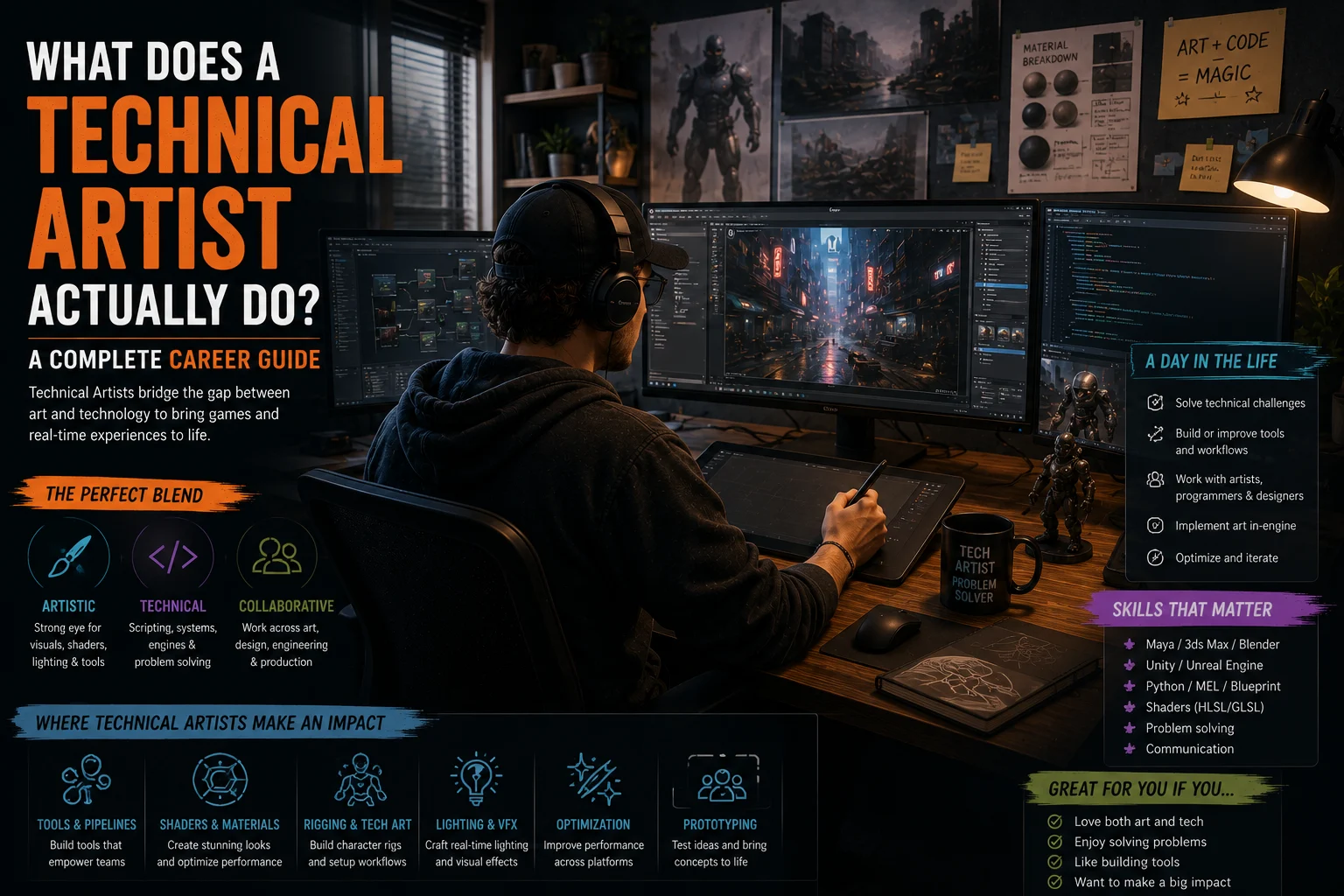
The technical artist role is one of the most misunderstood and underappreciated positions in the games and animation industries. What remains consistent is the core value: bridging the gap between creative vision and technical constraints. If you are considering a career as a technical artist, browse current technical artist job openings on PixelCareer.
The Core Responsibility of a Technical Artist
Technical artists exist to solve problems at the intersection of art and technology. When an artist cannot achieve a visual result because of a technical constraint, a technical artist finds a way around it. When a pipeline is inefficient, a technical artist identifies the bottleneck and builds a solution. They are as much engineers as artists — and the best ones are genuinely excellent at both.
What Technical Artists Actually Do Day to Day
Shader and material development: Creating shaders and material systems that determine how surfaces look when rendered — requiring both artistic sensibility and technical knowledge.
Pipeline and tool development: Building scripts, plugins, and tools that automate repetitive tasks and ensure consistency. Most technical artists write Python for pipeline work.
Asset integration and optimisation: Ensuring art assets are correctly integrated and perform within technical budgets — polygon counts, draw calls, memory usage, and render performance.
Rigging and skinning: Building joint systems, control rigs, and deformation systems that allow animators to pose and animate characters.
VFX and real-time effects: Developing real-time visual effects using particle systems and shader-based effects in tools like Unreal Engine’s Niagara or Unity’s VFX Graph.
Mentoring and support: At senior level, supporting other artists — answering technical questions, reviewing assets for pipeline compliance, helping the art team work within constraints.
Specialisations Within Technical Art
Character Technical Artist: Character rigging, skinning, and systems supporting character animation.
Environment Technical Artist: Terrain systems, material blending, level of detail systems, and tools supporting environment artists.
VFX Technical Artist: Real-time visual effects, particle systems, shader-based effects, and destruction simulations.
Pipeline Technical Artist: Tools and workflows supporting the broader production pipeline — import/export scripts and automation tools.
Lighting Technical Artist: Lighting systems, light budgets, and ensuring lighting goals are achievable within engine constraints.
Cinematic Technical Artist: Facial animation systems, motion capture integration, and sequencing tools for cutscene production.
The Skills a Technical Artist Needs
Programming ability: Python for scripting and automation is near-universal. Engine-specific scripting — Blueprints in Unreal or C# in Unity — is also frequently required.
Artistic foundation: A technical artist who cannot evaluate artistic quality is significantly less valuable than one combining technical ability with genuine artistic sensibility.
Deep knowledge of at least one DCC tool: Maya is most common. Blender is increasingly used. Houdini is essential for certain simulation specialisations.
Real-time engine experience: For games roles, Unreal Engine or Unity experience is essential.
Problem-solving mindset: Technical art requires creative resourcefulness in approaching novel, undocumented problems.
How Technical Art Differs Between Games and Film
In games, the primary constraint is real-time performance — every asset must run at an acceptable frame rate on target hardware. In film and VFX, the constraint is render time and pipeline complexity. Technical artists in film work with offline renderers like Arnold, RenderMan, or V-Ray.
Frequently Asked Questions
Do technical artists need to know how to code?
Yes — programming ability is a core requirement in most studios, not an optional bonus. Python is most commonly required. Candidates with no programming experience will find themselves at a significant disadvantage.
Is technical art a good career path?
Excellent — in consistent demand across games, film, and VFX. The combination of artistic and technical skills required means strong technical artists are relatively scarce compared to demand. Compensation is typically higher than equivalent pure art roles.
What is the difference between a technical artist and a TD?
A Technical Director in film sits closer to the engineering side of the pipeline. TDs in film are often primarily software engineers. Technical artists maintain a stronger artistic practice alongside their technical work.
What software should a technical artist know?
For games: Unreal Engine or Unity plus Maya or Blender, Python for scripting. For film and VFX: Maya, Houdini, and familiarity with offline renderers like Arnold. Substance Designer and Painter are widely used across both industries.
Can I become a technical artist without an art degree?
Yes — many come from non-traditional backgrounds. What matters is your portfolio demonstrating technical art capabilities and your ability to show both artistic understanding and technical competence.
Final Thoughts
Technical art is one of the most intellectually demanding and professionally rewarding positions in the creative production industry. For people equally drawn to artistic and technical sides of production, it is a career path worth pursuing seriously. Browse technical artist jobs on PixelCareer.